

Table of Contents
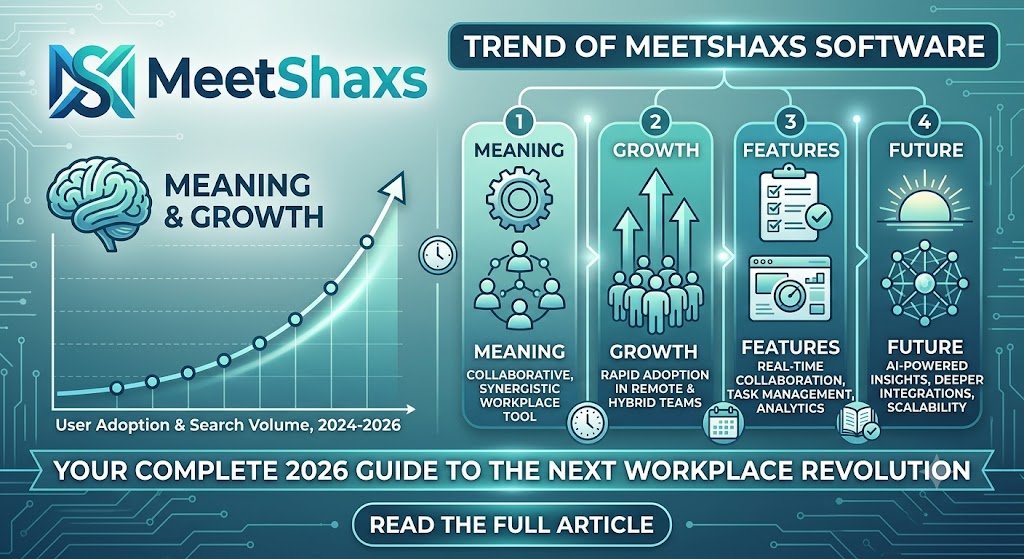
The trend of MeetShaxs software has become an unusual but increasingly visible search topic among readers who want to understand new software platforms, digital collaboration, automation, and the future of connected work. The phrase does not yet have one universally accepted definition. Some online sources describe MeetShaxs as a collaboration-focused software platform, while others use the name more broadly for software learning, innovation, and business technology. Because those descriptions vary, this guide takes a careful, practical approach instead of presenting unverified marketing claims as established facts.
At its most useful, the topic can be understood as part of a wider movement toward integrated software that combines communication, task management, automation, data access, and intelligent assistance. Rather than forcing users to move between many disconnected applications, the trend of MeetShaxs software reflects growing interest in simpler digital environments where work, meetings, documents, decisions, and follow-up activities can remain connected.
What Is the Trend of MeetShaxs Software?
The term generally refers to the growing online discussion around MeetShaxs as a modern software concept or possible collaboration platform. Depending on the source, it may be presented as a tool for remote meetings, team communication, workflow management, software improvement, skill development, or digital business growth.
This lack of a consistent official definition is important because readers should not assume that every feature mentioned online has been independently confirmed. Marketing descriptions, third-party articles, and actual product documentation are not always the same thing.
A balanced interpretation is that the trend of MeetShaxs software represents demand for flexible, all-in-one business technology. Users increasingly expect software to do more than one narrow task. They want meetings to connect with projects, conversations to connect with files, and decisions to connect with action items.
In that sense, MeetShaxs fits into a recognizable software trend even when specific product details remain unclear.
| Aspect | Practical Meaning |
| Core idea | Connected software for communication, organization, and productivity |
| Main audience | Remote teams, small businesses, educators, freelancers, and project groups |
| Common themes | AI assistance, automation, collaboration, integration, and personalization |
| Main caution | Product claims should be checked against official documentation before adoption |
| Search intent | Primarily informational, with some commercial and navigational interest |
Why the Trend Is Attracting Attention
People are tired of fragmented digital work. A team may use one application for video meetings, another for chat, a third for task tracking, a fourth for file storage, and several smaller tools for notes, approvals, scheduling, or reporting.
Each application may work well independently, but the combined experience can become difficult to manage. Employees may waste time searching for files, checking multiple notifications, copying information between platforms, or asking colleagues for updates that already exist somewhere else.
The trend of MeetShaxs software attracts attention because it appears to promise consolidation. The appeal is not simply about receiving more features. It is about reducing handoffs, preventing lost updates, and spending less time searching for information.
A connected workspace can make responsibilities clearer because conversations, documents, deadlines, and decisions become easier to trace. Instead of trying to remember what was agreed during a meeting, users may be able to connect the meeting record directly with the related task or project.
This interest also matches the broader direction of workplace technology. Microsoft’s recent Work Trend Index research focuses heavily on AI-assisted work, human-agent collaboration, and the redesign of organizational workflows, showing that intelligent software is moving from isolated experimentation toward deeper operational use.
The Shift from Standalone Tools to Unified Platforms
Older business software was often designed around one function. Accounting systems handled accounts, meeting applications handled calls, and project tools handled tasks. Modern users still need specialized functions, but they increasingly value platforms that can share information without repeated manual entry.
This is where the trend of MeetShaxs software becomes relevant. A unified platform can reduce the gap between discussion and execution. For example, a meeting note can become a task, the task can receive an owner, the owner can attach a document, and the completed work can appear in a project report.
The value comes from continuity rather than from any single feature. When information moves smoothly through a workflow, team members do not have to rebuild the context at every stage.
However, unification must be handled carefully. A platform that attempts to do everything can become cluttered, slow, or confusing. Users may struggle to find simple controls because too many unrelated options compete for attention.
The strongest approach is usually modular. Users receive a reliable core system and activate only the features that match their work. This allows a platform to serve different teams without forcing every user to work through the same complicated interface.
Artificial Intelligence as a Central Growth Driver
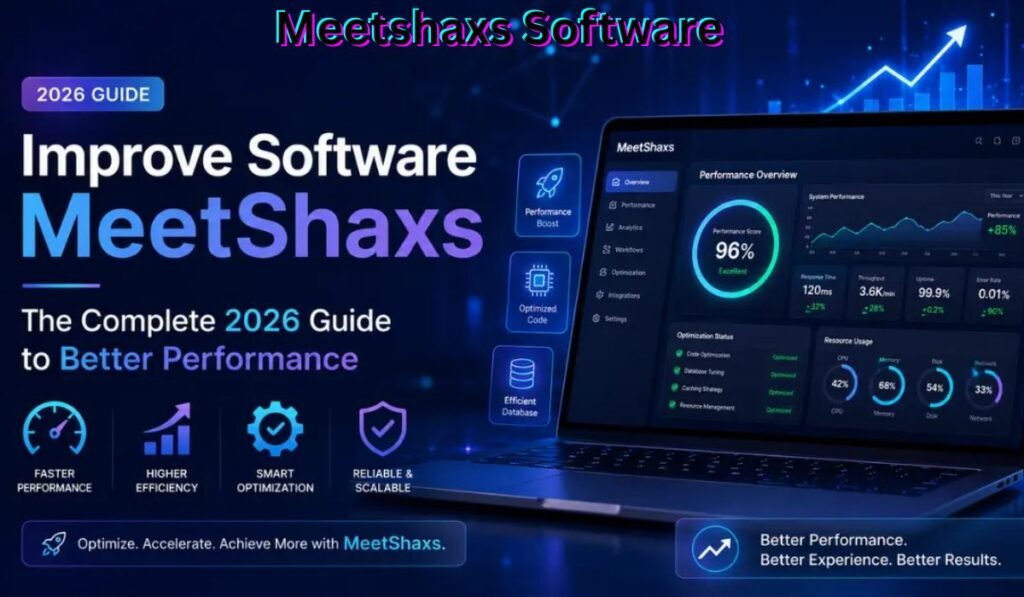
Artificial intelligence is one of the strongest ideas associated with the trend of MeetShaxs software. In a useful implementation, AI should reduce effort without hiding important decisions. It may summarize meetings, identify follow-up actions, organize information, suggest priorities, or help users locate files and conversations more quickly.
The real test is whether the AI improves outcomes. A long transcript is not automatically valuable. A concise summary containing accurate decisions, named responsibilities, and realistic due dates is far more practical.
Similarly, an AI assistant should not simply generate more notifications. It should help users understand what deserves attention, what can wait, and why a particular action has been recommended.
An intelligent meeting system might detect that a deadline was agreed upon, connect it with the correct project, and suggest an owner. A responsible system would still allow users to review and correct the recommendation before it becomes part of the official workflow.
Microsoft’s workplace research describes a growing role for AI agents and human-agent collaboration, but it also emphasizes organizational readiness, governance, and the ability of people to use AI effectively. That distinction matters because software adoption alone does not create productivity. Clear processes, training, and accountability remain essential.
| AI Capability | Potential Value | Main Risk |
| Meeting summaries | Faster review and clearer decisions | Missing context or inaccurate interpretation |
| Action-item detection | Less manual follow-up | Incorrect ownership or deadlines |
| Smart search | Faster access to scattered information | Privacy and permission errors |
| Workflow suggestions | Better prioritization | Overreliance on automated recommendations |
| Content generation | Quicker drafting and documentation | Generic, incorrect, or confidential output |
Remote and Hybrid Work as a Major Use Case
The trend of MeetShaxs software is closely connected with remote and hybrid work because distributed teams need shared visibility. When people work in different locations or time zones, they cannot depend on informal office conversations.
Important information must be documented in a way that remains accessible after a call ends. Employees should not need to attend every meeting simply to understand what was decided.
A strong collaboration system should support both synchronous and asynchronous work. Live meetings are valuable for discussion, negotiation, brainstorming, and complex problem-solving. Asynchronous communication is often more suitable for status updates, recorded explanations, document reviews, and work that does not require everyone to be present at the same moment.
Software becomes more useful when it respects both approaches. Users should be able to move from a live conversation to a recorded summary, from a summary to a task, and from a task to a progress update without rebuilding the context each time.
This continuity is one reason the concept continues to gain search interest. It reflects a wider demand for software that keeps teams aligned without filling every calendar with unnecessary meetings.
Automation Without Unnecessary Complexity
Automation is another major part of the trend of MeetShaxs software. Businesses want repetitive steps to happen automatically, but they do not want to spend weeks building complicated systems.
The ideal platform makes common workflows easy to create while leaving advanced controls available for teams that genuinely need them. Automation should simplify a process rather than turn it into a technical project.
A practical automation might assign a task when a form is submitted, notify a manager when approval is required, update a project stage when work is completed, or send a reminder before a deadline.
These actions may appear small, but together they can remove a significant amount of routine administration. Employees can spend more time solving problems instead of copying information, sending reminders, or checking whether the next step has started.
The danger appears when automation becomes invisible. Users should know what triggered an action, which data was used, and how the result can be corrected.
Transparent automation builds trust. Hidden automation creates confusion, especially when responsibilities, customer communication, payments, or sensitive information are involved.
Personalization and Modular Workspace Design
Different teams rarely need the same dashboard. A sales group may care about leads, follow-ups, customer conversations, and revenue forecasts. A development team may focus on issues, releases, code reviews, testing, and technical incidents.
An education team may need classes, assignments, attendance records, lesson resources, and communication tools. A healthcare organization may prioritize appointments, documentation, access controls, and secure internal coordination.
The trend of MeetShaxs software reflects interest in workspaces that can be adapted without rebuilding the entire system. Personalization may include custom views, role-based dashboards, reusable templates, notification preferences, and modular extensions.
The goal is to make the platform feel relevant rather than overloaded. Users should see the information that supports their responsibilities instead of being distracted by every feature available across the organization.
Good personalization should still preserve consistency. If every user creates a completely different system, collaboration becomes harder.
A better model gives individuals flexible views while maintaining shared rules for naming, permissions, status labels, project stages, and record keeping. Personal freedom and organizational consistency should support each other.
Integrations, APIs, and Connected Workflows
No modern platform operates in complete isolation. Even an all-in-one system must connect with email, calendars, cloud storage, customer databases, payment tools, analytics services, and specialized industry applications.
That is why integrations are central to the trend of MeetShaxs software. Users want information to move between their existing tools without repeated copying or manual updates.
An integration should do more than transfer data. It should preserve context, permissions, ownership, and accuracy.
A calendar event linked to a project should show why the meeting matters. A file imported from cloud storage should retain suitable access controls. A customer update transferred into a workflow should not expose private information to the wrong department.
APIs make these connections possible, but they also create security responsibilities. OWASP maintains a dedicated API Security project because authentication failures, authorization weaknesses, and other API risks can expose systems and data. Any platform promoted as highly connected should therefore be evaluated for both integration quality and security design.
| Integration Area | Useful Connection | Evaluation Question |
| Email and calendar | Meetings, reminders, and follow-ups | Does synchronization work in both directions? |
| Cloud storage | Shared documents and version access | Are original permissions preserved? |
| CRM systems | Customer records and activity history | Can access be limited by role? |
| Project tools | Tasks, status changes, and reporting | Are duplicate records prevented? |
| Developer tools | Issues, releases, and technical updates | Is the API documented and secure? |
Security, Privacy, and User Trust
The trend of MeetShaxs software should not be evaluated only through convenience. A platform that stores conversations, files, tasks, meeting records, customer information, and AI-generated summaries may hold a detailed picture of an organization.
Security and privacy must therefore be treated as core product requirements rather than optional premium features.
Useful questions include how accounts are protected, whether multi-factor authentication is available, how permissions are assigned, where data is stored, how long information is retained, and whether users can export or permanently delete their records.
Organizations should also ask how AI features handle confidential content. It should be clear whether customer information is used to train models, transferred to outside providers, or stored beyond the original business purpose.
NIST’s zero trust guidance explains that modern security should focus on users, assets, and resources rather than assuming that everything inside a network is trustworthy. OWASP also provides widely used standards and testing guidance for web application security. These principles offer a stronger evaluation basis than vague claims such as “enterprise-grade protection.”
User Experience and the Importance of Simplicity
Feature-rich software can fail when people do not understand how to use it. The trend of MeetShaxs software will have lasting value only if the experience remains clear for ordinary users, not just technical administrators.
Navigation, onboarding, search, notifications, and error messages all shape whether a platform becomes part of daily work. A product can have powerful technology and still fail if common actions feel confusing.
A good interface reduces unnecessary decisions. Users should quickly understand where to begin, what requires attention, and what happens after they take an action.
Common tasks should feel predictable, while advanced options should remain available without dominating the screen. Users should not need extensive training to schedule a meeting, locate a file, update a task, or review a decision.
Accessibility also matters. Keyboard navigation, readable contrast, clear labels, captions, screen-reader compatibility, and mobile-friendly layouts are not decorative extras.
They determine whether more people can use the system reliably. A platform that claims to improve collaboration should not exclude users through poor design choices.
Business Value for Small and Growing Organizations
Small businesses often feel the pain of disconnected tools more strongly because they have limited time for administration. The trend of MeetShaxs software may appeal to these organizations if it combines essential functions at a reasonable cost and does not require a large technical team.
The strongest value would come from faster coordination, clearer ownership, simpler reporting, and fewer repeated subscriptions. A small company may benefit when one connected system replaces several overlapping tools.
However, buyers should calculate the full cost rather than comparing only monthly subscription prices. Migration, training, customization, integration, support, data storage, and future price changes can affect the real return on investment.
A sensible adoption decision starts with a specific problem. A company should identify what is currently slow, confusing, expensive, or unreliable.
It can then test whether the software improves that process. Buying a platform because it appears trendy usually produces weaker results than selecting it against measurable operational needs.
Potential Applications Across Different Industries
The trend of MeetShaxs software can be understood through several potential use cases. A professional services firm may use a connected workspace to manage client meetings, deliverables, approvals, internal notes, and project deadlines.
A school or educational institution may use it for staff coordination, virtual sessions, learning resources, assignment workflows, and communication between departments.
A distributed creative team may connect client briefs, design reviews, revision requests, approvals, and final files. Instead of searching through long email threads, team members may be able to see the complete history of a project in one place.
Healthcare, finance, and legal organizations would require stricter controls because their information may be regulated or highly sensitive. For them, convenience cannot replace compliance, auditability, contractual clarity, and secure access management.
The most important point is that software value depends on workflow fit. The same feature may be essential for one team and unnecessary for another.
Industry relevance should be demonstrated through actual processes, security requirements, and measurable outcomes rather than generic claims that the platform can serve everyone.
How MeetShaxs May Support Better Decision-Making
A useful collaboration platform should do more than store information. It should make decisions easier to understand and follow.
The trend of MeetShaxs software may be connected with this need because modern teams often struggle to remember why a decision was made, who approved it, and what action was supposed to follow.
A structured decision record can include the original problem, available options, related evidence, comments from participants, the final choice, and the person responsible for implementation.
This creates accountability without forcing employees to search through meeting recordings, messages, emails, and documents.
AI may improve this process by identifying decisions within conversations and suggesting related tasks. However, the final record should be reviewed by a person.
Important business decisions should not be treated as confirmed simply because an automated system interpreted a sentence as an agreement.
Challenges That Could Limit Long-Term Adoption
Every growing software concept faces challenges. The trend of MeetShaxs software may lose momentum if product descriptions remain unclear, performance becomes unreliable, or users cannot understand the difference between MeetShaxs and established collaboration tools.
Another challenge is feature overload. When a platform adds meetings, chat, tasks, AI, file storage, analytics, automation, customer management, and many other functions, the interface may become difficult to navigate.
Integration quality can also become a problem. A long list of supported applications looks impressive, but users need connections that remain stable after updates.
Pricing presents another risk. A low starting price may become expensive when businesses require additional storage, premium automation, administrative controls, AI usage, integrations, or advanced support.
Long-term adoption depends on predictable value. Customers need to know what they are paying for, what limits apply, and how easily they can retrieve their data if they decide to leave.
Limitations and Questions That Still Need Clear Answers
The online discussion around the trend of MeetShaxs software contains inconsistent descriptions. Some pages discuss it as a collaboration platform, while others describe it as a broad technology concept connected with software learning, skill development, and earning opportunities.
This inconsistency means readers should be cautious about treating third-party articles as official product documentation.
Before adopting any product under this name, users should verify the legal company identity, official website, pricing, feature documentation, privacy policy, terms of service, support channels, security information, and genuine customer references.
A trial should be tested with non-sensitive information first. This allows an organization to evaluate the system without placing confidential business or customer data at unnecessary risk.
The absence of clear public documentation does not automatically mean a product is unsafe. It does mean that buyers should demand stronger evidence.
Trustworthy software vendors explain what their product does, how data is handled, what support is available, and what happens when a customer decides to cancel or migrate.
How to Evaluate MeetShaxs Software Before Adoption
A practical evaluation of the trend of MeetShaxs software should focus on evidence rather than excitement. Begin with one real workflow and test it from start to finish.
Observe how long setup takes, whether team members understand the interface, how reliably integrations work, and whether information remains easy to locate after several days of activity.
Security testing should include account controls, permissions, data exports, deletion options, administrator logs, and access from different devices.
The organization should also review contracts and privacy documents before uploading confidential material. When AI features are involved, users should test accuracy and establish a human review process.
A pilot project is usually more informative than a polished demonstration. Demonstrations show the ideal path. Pilots reveal friction, missing features, training needs, technical limitations, and unexpected costs.
The final decision should consider user feedback, technical fit, security, support quality, migration requirements, and total ownership cost.
| Evaluation Category | What to Test | Positive Sign |
| Usability | Setup, navigation, search, and daily tasks | New users become productive quickly |
| Reliability | Calls, syncing, notifications, and updates | Consistent performance during real work |
| Security | Authentication, permissions, logs, and exports | Clear controls with documented policies |
| Integration | Calendar, storage, CRM, and project tools | Stable connections without duplicate data |
| Support | Response quality and documentation | Clear guidance and accountable assistance |
| Cost | Subscription, migration, training, and add-ons | Predictable pricing tied to measurable value |
The Future of the Trend of MeetShaxs Software

The future of the trend of MeetShaxs software will likely depend on clarity, trust, and practical usefulness. Interest alone is not enough.
To become a credible long-term platform or recognized software category, MeetShaxs would need consistent product information, dependable performance, transparent security practices, and a clear explanation of who the software is designed to serve.
The wider market direction favors AI-assisted workflows, connected platforms, modular design, asynchronous collaboration, and stronger identity-based security.
MeetShaxs can benefit from those shifts if it turns broad promises into verifiable capabilities. The product experience must show that users can save time, reduce confusion, and maintain control over their information.
The strongest future version would not necessarily attempt to replace every application. It could instead become a dependable coordination layer that connects people, decisions, content, and action while allowing specialized tools to remain part of the workflow.
That approach would offer flexibility without forcing users to abandon systems that already work well.
My Opinion on MeetShaxs Software
In my opinion, the trend of MeetShaxs software is interesting less because of one clearly proven product and more because it reflects what users now expect from modern software.
People want fewer disconnected tools, smarter assistance, clearer workflows, and more control over how their workspace is organized.
At the same time, I would not recommend choosing a platform based only on trending articles. The available online descriptions are too inconsistent to justify strong assumptions about exact features, security, or performance.
I would look for official documentation, a transparent privacy policy, a realistic trial, clear pricing, and verifiable support before moving important work or customer data into the system.
The concept has potential. Its credibility will depend on whether the real user experience matches the language used around it.
A platform does not become valuable merely because it includes artificial intelligence or appears in search results. It becomes valuable when ordinary users can complete their work more clearly, securely, and efficiently.
Conclusion
The trend of MeetShaxs software sits at the intersection of several important technology movements, including integrated collaboration, AI assistance, workflow automation, personalization, remote work, and secure data access.
These ideas respond to real problems faced by teams that are overwhelmed by scattered applications and disconnected information.
However, readers should distinguish between the broader trend and verified product facts. MeetShaxs is described differently across online sources, so careful evaluation is essential.
Businesses should test real workflows, review security and privacy terms, calculate total cost, and confirm that the platform solves a specific operational problem.
When approached with realistic expectations, the trend of MeetShaxs software offers a useful lens for understanding where workplace technology may be heading.
The future belongs to software that connects tasks without creating clutter, uses AI without removing human judgment, and improves collaboration without weakening security or user control.
Frequently Asked Questions
What does the trend of MeetShaxs software mean?
The trend of MeetShaxs software refers to growing online interest in MeetShaxs as a modern software concept associated with collaboration, automation, artificial intelligence, remote work, and connected business workflows.
Because public descriptions vary, users should confirm exact product features through official documentation before making a purchase or moving business data onto the platform.
Is MeetShaxs a real collaboration platform?
Several websites describe MeetShaxs as a collaboration or all-in-one productivity platform, but the publicly available information is not fully consistent.
A potential user should verify the official vendor, product access, pricing, service terms, security documents, privacy policy, and customer-support details before relying on third-party descriptions.
Why is MeetShaxs software becoming popular?
Interest appears to be driven by demand for simpler and more integrated software. Teams want meetings, messages, files, tasks, automation, and AI assistance to work together.
The trend of MeetShaxs software fits this wider preference for connected digital workspaces that reduce app switching and make information easier to follow.
Is MeetShaxs software safe for business data?
Safety cannot be confirmed from general trend articles alone. Businesses should examine authentication options, permissions, encryption information, data location, retention policies, audit logs, privacy terms, and incident-response procedures.
Sensitive business or customer information should not be uploaded until these areas have been reviewed carefully.
How should a company test MeetShaxs software?
A company should begin with a limited pilot using non-sensitive data. It should test one complete workflow, evaluate usability and integrations, review security controls, collect employee feedback, and compare the total cost with measurable process improvements.
The final decision should be based on practical evidence rather than promotional claims and more.
