

Table of Contents
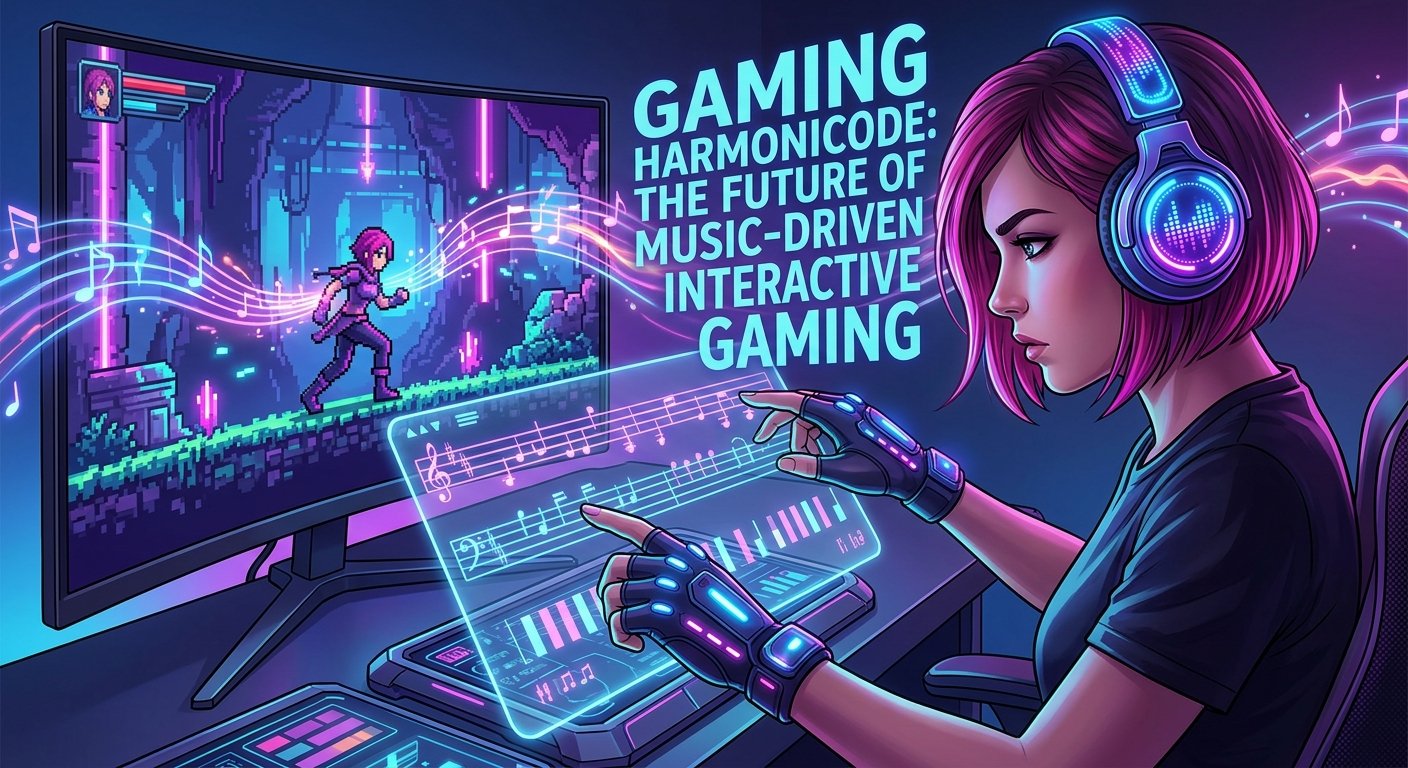
Gaming harmonicode is an emerging concept that brings together video games, music, rhythm, interactive sound, pattern recognition, and responsive technology. Instead of treating music as something that simply plays in the background, this approach makes sound an active part of the gaming experience. A player’s movement, timing, decisions, or achievements can influence what they hear and how the virtual world responds.
The phrase gaming harmonicode is not currently a standardized gaming genre with one universally accepted definition. It is used online to describe several closely related ideas, particularly games that connect musical patterns and audio feedback with gameplay mechanics. Recent discussions around HarmoniCode-style games emphasize listening, reproducing sequences, timing, pattern recognition, and interactive feedback.
That ambiguity actually makes gaming harmonicode interesting. It represents a broader design philosophy rather than a rigid category. At its best, it can make gameplay feel more immersive, expressive, and memorable by turning sound into something the player actively interacts with rather than merely hears.
What Is Gaming Harmonicode?
Gaming harmonicode can be understood as the intersection of interactive gaming and musical logic. The basic idea is simple: sound, rhythm, harmony, or musical patterns become connected to what the player does inside a game.
In a conventional action game, music may become faster during an intense battle, but the player does not necessarily control the composition. In a harmonicode-style experience, the relationship can go much further. A successful action might trigger a musical note, a sequence of correct inputs could create a melody, or a particular rhythm could open a pathway in the game world.
This makes gaming harmonicode different from simply adding a good soundtrack to a video game. The audio becomes part of the gameplay system.
| Element | Traditional Gaming | Gaming Harmonicode |
| Music | Often atmospheric or emotional | Can directly influence gameplay |
| Player input | Controls characters or objects | Can also create or manipulate sound |
| Rhythm | Usually optional | May become a core mechanic |
| Feedback | Visual, vibration, and audio | Strongly connected to musical feedback |
| Progression | Levels, missions, objectives | Can include musical patterns and sequences |
| Replayability | Depends on gameplay variety | Can increase through timing and musical mastery |
The concept overlaps with rhythm games, music games, puzzle games, educational games, and experimental interactive entertainment. However, gaming harmonicode can extend beyond any one of those categories because its defining feature is the relationship between sound and interaction.
Why Gaming Harmonicode Is Becoming Interesting
Modern players are increasingly familiar with games that react dynamically to their actions. Adaptive difficulty, procedural generation, spatial audio, haptic feedback, and personalized experiences have all made games more responsive.
Gaming harmonicode fits naturally into this evolution because sound is one of the fastest ways to communicate information. A short tone can tell a player that an action succeeded. A change in rhythm can signal danger. A musical phrase can communicate progress without requiring another text box or visual notification.
There is also a creative reason for its appeal. Games traditionally give players control over movement, strategy, exploration, or combat. Interactive music gives them another layer of expression. The player is no longer simply completing a level; in certain implementations, the player is helping create the atmosphere of that level.
Recent HarmoniCode-related gaming content describes musical puzzle experiences in which players listen to patterns, reproduce sequences, and receive immediate feedback. Other discussions frame the broader concept around music-driven mechanics and real-time interaction.
My opinion is that this is where the idea becomes genuinely valuable. Gaming harmonicode does not need to replace traditional gaming. It can simply give developers another tool for creating games that feel different from the usual visual-first experience.
How Gaming Harmonicode Gameplay Works
The exact mechanics depend on the game, but the central loop often revolves around listening, interpreting, responding, and receiving feedback.
Imagine entering a digital environment where several glowing objects represent different musical tones. The game plays a short sequence. Instead of simply remembering the colors, the player must identify the sound pattern and reproduce it through movement or button inputs.
The game then evaluates accuracy. Correct timing may increase the score, while mistakes could alter the melody or interrupt the sequence. As the player becomes more skilled, the game can introduce longer patterns, faster tempos, additional sounds, or more complicated combinations.
This creates an unusual relationship between memory and motor control. The player needs to hear something, understand it, remember it, and translate it into an action.
| Gameplay Stage | Player Experience | Possible Game Response |
| Audio cue | Player hears a pattern | Visual or musical signal appears |
| Interpretation | Player identifies rhythm or sequence | Game waits for a response |
| Input | Player performs an action | System checks timing and accuracy |
| Feedback | Player hears or sees the result | Score, combo, or progression changes |
| Mastery | Player repeats the challenge | Difficulty increases |
The strongest gaming harmonicode experiences would make this process feel natural rather than technical. Players should understand the rules through play instead of reading a lengthy explanation before starting.
The Role of Rhythm, Harmony, and Timing
Rhythm is one of the most accessible components of music because people naturally recognize repetition and timing. A game can use that instinct to create mechanics that are easy to understand but difficult to master.
Timing can determine whether an action succeeds. A player might need to press a button exactly when a beat reaches a marker, move through an environment according to a rhythm, or synchronize several actions with a changing musical pattern.
Harmony adds another layer. Instead of asking the player to recognize one sound at a time, a game can introduce combinations of notes or complementary tones. That can turn a simple reaction challenge into a puzzle involving relationships between sounds.
In gaming harmonicode, these musical components can also communicate information. A particular chord might indicate that a puzzle is close to being solved. A darker musical progression could suggest danger. A successful combination might transform a previously empty environment into a vibrant musical space.
The important point is that sound does not have to be decorative. It can carry information.
Gaming Harmonicode and Player Immersion
Immersion is one of the strongest arguments for interactive audio. Humans do not experience virtual environments through vision alone. Sound can create a sense of distance, movement, tension, location, and emotional change.
Gaming harmonicode takes this principle a step further by connecting sound with agency. When a player knows that their actions are changing the music, the game world can feel more responsive.
Consider a fantasy game in which the player explores an ancient temple. Instead of finding a conventional key to open a door, the player discovers a sequence of tones. Reproducing the correct pattern causes the architecture to respond. The music changes, the walls move, and a new route becomes available.
The result is more than a puzzle with sound effects. The audio becomes part of the fictional world.
That kind of integration can make ordinary interactions feel meaningful. Even a simple movement mechanic can become memorable if the player is simultaneously shaping a musical pattern.
The Technology Behind Gaming Harmonicode
Creating this type of experience requires more than adding music files to a game engine. Developers need systems capable of connecting player inputs with audio events in real time.
Modern game engines can already respond to player actions, detect events, manage animations, and play audio. A harmonicode-style system can connect those capabilities through rules that determine how musical events should respond to gameplay.
For example, a game could assign different notes to specific player actions. A sequence of successful actions could create a chord progression. The system might also alter tempo, instrumentation, volume, or musical complexity according to the player’s performance.
| Technology Area | Purpose in Gaming Harmonicode |
| Game engine | Controls gameplay and interactive events |
| Audio engine | Manages real-time sound and music |
| Input system | Detects keyboard, controller, touch, or instrument actions |
| Timing system | Measures rhythm and input accuracy |
| Adaptive logic | Changes audio or difficulty according to performance |
| Spatial audio | Places sounds within the virtual environment |
| MIDI or musical interfaces | Can connect physical musical inputs to gameplay |
Low latency is particularly important. If a player presses a button and the resulting sound arrives noticeably late, the relationship between action and feedback becomes confusing.
Calibration can therefore be valuable, particularly in rhythm-heavy experiences. The game needs to understand how input timing, audio output, and display timing relate to one another.
Gaming Harmonicode as a Learning Experience
The educational potential of gaming harmonicode is another reason the concept deserves attention. Games are effective learning environments when they provide immediate feedback, meaningful challenges, and opportunities to practice.
A musical game could teach rhythm without feeling like a traditional lesson. A puzzle could introduce sequencing and pattern recognition through sound. A creative game could help players understand basic musical relationships by allowing them to experiment.
This does not mean every harmonicode game should become an educational product. Entertainment should remain a legitimate goal. However, the same mechanics that make a game enjoyable can sometimes develop useful skills.
Pattern recognition, concentration, timing, memory, and coordination can all become part of the experience.
The key is good design. A game should not claim educational value simply because it contains music. The learning opportunity has to emerge naturally from the mechanics.
Designing Better Gaming Harmonicode Experiences
Good design begins with clarity. If players cannot understand why a particular sound matters, the musical mechanic may feel arbitrary.
A strong gaming harmonicode system should establish a clear relationship between action and sound. When the player does something correctly, the feedback should be recognizable. When an input is incorrect, the game should communicate the mistake without becoming frustrating.
Difficulty also needs careful management. A beginner should not be expected to identify complicated musical structures immediately. Early levels can use short patterns and generous timing windows before gradually introducing more demanding challenges.
Another important consideration is repetition. Musical games often depend on practice, but repetition should not feel like punishment. The player should feel that another attempt provides a genuine opportunity to improve.
This is where adaptive systems can become useful. Instead of simply increasing speed, a game could identify the player’s weakness and adjust the challenge accordingly.
Accessibility and Audio Design
Accessibility is especially important when sound becomes central to gameplay. A player should not be excluded simply because the game assumes everyone can hear exactly the same frequencies, volumes, or musical details.
Gaming harmonicode developers should think carefully about visual alternatives, adjustable audio levels, captions where appropriate, remappable controls, timing options, and clear interface feedback.
Accessibility does not necessarily weaken a musical mechanic. In many cases, it makes the design stronger because it forces developers to communicate information through multiple channels.
A game might represent a musical sequence through color, shape, vibration, animation, or visual timing indicators while preserving the original audio experience for players who want it.
This approach can also benefit experienced players. Someone playing in a noisy environment might appreciate visual timing indicators even if they have no hearing difficulty.
Gaming Harmonicode Across Different Platforms
The concept can work on PCs, consoles, smartphones, tablets, and potentially specialized musical hardware. Each platform introduces different opportunities and limitations.
On a smartphone, touch controls can make musical interaction highly accessible. Players can tap, swipe, hold, and drag across virtual instruments. However, small screens can make complex musical interfaces difficult to manage.
PC gaming provides more control options and can support keyboards, controllers, MIDI devices, and specialized peripherals. Consoles offer consistent hardware and strong audiovisual capabilities.
Cloud gaming could also influence the future of gaming harmonicode, although latency remains an important consideration. When a mechanic depends on precise timing between player action and sound, even small delays can affect the experience.
| Platform | Major Strength | Potential Challenge |
| PC | Flexible controls and hardware | Hardware differences |
| Console | Consistent controller experience | Limited customization |
| Mobile | Touchscreen accessibility | Screen size and latency |
| Tablet | Larger touch interface | Device performance differences |
| Musical hardware | Highly expressive input | Higher entry cost |
| Cloud gaming | Broad device access | Network latency |
How Developers Can Make the Concept More Engaging

The most successful gaming harmonicode experiences will probably avoid making music feel like an isolated mini-game. Instead, sound should be connected to the larger purpose of the experience.
Storytelling offers one opportunity. A game could use musical patterns as a fictional language. Players might gradually learn the sounds of different characters, locations, or factions.
Exploration offers another. Different environments could have unique musical systems, allowing players to discover hidden relationships by listening carefully.
Competition can also work. Players could compare timing accuracy, composition quality, or creative solutions. However, competitive scoring should not become the only measure of success. Creativity and experimentation can be equally valuable.
The broader goal should be to make the player feel that their interaction matters.
Gaming Harmonicode Compared With Traditional Rhythm Games
Gaming harmonicode shares important characteristics with rhythm games, but the two concepts are not necessarily identical.
A traditional rhythm game commonly asks players to perform actions in synchronization with predetermined music. The player’s performance is measured against timing windows.
A harmonicode-style experience can use the same principle but potentially expand it. The player might influence the music itself, solve musical puzzles, alter the environment through sound, or create combinations that were not completely predetermined.
| Feature | Rhythm Game | Gaming Harmonicode Concept |
| Timing | Central | Often central |
| Music | Usually predetermined | Can be responsive or interactive |
| Player expression | Performance-focused | Potentially creative and exploratory |
| Puzzle elements | Sometimes present | Can be deeply integrated |
| Sound as gameplay | Common | Fundamental concept |
| Dynamic composition | Limited in many titles | Potentially central |
This distinction is important because gaming harmonicode should not simply be treated as another name for every music-based game.
The Future of Gaming Harmonicode
The future of gaming harmonicode will depend on how creatively developers use emerging technology. More responsive audio systems, improved spatial sound, artificial intelligence, procedural music, and adaptive gameplay could make interactive sound considerably more sophisticated.
Imagine a game that generates a unique musical atmosphere based on the player’s behavior. A cautious player might create a slower, quieter environment, while an aggressive player generates faster and more energetic music.
Procedural systems could also allow music to change without sounding repetitive. Instead of looping the same soundtrack, the game could assemble musical elements according to the player’s location, actions, and progress.
Artificial intelligence could potentially help games analyze player timing and dynamically adjust musical complexity. It could also assist with creating variations that maintain musical coherence while responding to gameplay.
These possibilities remain dependent on implementation quality. Technology alone does not guarantee a better game. The experience must still have clear rules, satisfying feedback, meaningful progression, and an enjoyable core loop.
Why Gaming Harmonicode Could Matter to Game Design
The deeper importance of gaming harmonicode is not simply the novelty of mixing games and music. It represents a broader shift toward interactive media in which different forms of expression influence one another.
Games have already combined visual storytelling, physics, social interaction, procedural systems, and narrative choices. Interactive music is another layer of that evolution.
When sound becomes an active mechanic, developers gain another language for communicating with players. Instead of displaying every piece of information through text or visual icons, the game can let players hear changes and understand them intuitively.
That can produce experiences that are more emotional and memorable.
For players, it also creates a different definition of skill. Traditional games may reward accuracy, strategy, exploration, or reaction speed. Gaming harmonicode can reward listening, timing, memory, interpretation, and musical creativity alongside those abilities.
My Opinion on Gaming Harmonicode
In my opinion, gaming harmonicode is most exciting when developers treat it as a genuine gameplay philosophy rather than a marketing phrase.
There is nothing automatically innovative about putting music into a game. Games have used memorable soundtracks and rhythm mechanics for decades. What makes the harmonicode idea interesting is the possibility that the player’s actions can meaningfully shape the audio experience.
I would personally rather play a simple game where my decisions create a satisfying musical result than a technically impressive game where the music is completely disconnected from what I am doing.
The biggest challenge will be balance. If the musical mechanic is too complicated, casual players may feel lost. If it is too simple, experienced players may become bored. The best games will probably make the basic interaction immediately understandable while offering deeper layers for players who want to master them.
That is why I see gaming harmonicode less as a single genre and more as a design direction. It gives developers permission to ask an interesting question: what if the player could play the game and the soundtrack at the same time?
Who Is Gaming Harmonicode Best Suited For?
Gaming harmonicode has potential appeal across several types of players because it can combine different forms of engagement.
Music enthusiasts may appreciate the opportunity to interact with rhythm and harmony. Puzzle fans can enjoy sequence-based challenges. Competitive players may enjoy precision and score chasing. Casual gamers may prefer short musical sessions that provide immediate feedback.
It can also appeal to people who enjoy creative experimentation. A well-designed game does not always need to tell players exactly what to do. Sometimes discovering how different sounds interact can become part of the fun.
This flexibility is one of the strongest aspects of the concept. The same underlying technology can support a relaxing musical exploration game, an intense rhythm challenge, a narrative adventure, or a puzzle experience.
What Makes a Good Gaming Harmonicode Game?
A successful game in this space needs more than attractive music. The relationship between sound and gameplay has to be understandable and satisfying.
Responsive controls are essential because musical interaction depends heavily on timing. Audio quality matters because unclear or poorly mixed sounds can make even excellent mechanics frustrating.
Progression is equally important. Players should feel that they are learning something as they advance. The game can introduce new rhythms, patterns, instruments, environments, or interactions without overwhelming the player.
Most importantly, the musical system should serve the game. If removing the music would make no difference to the gameplay, the experience probably has not fully embraced the harmonicode concept.
Gaming Harmonicode and the Broader Gaming Industry
The wider gaming industry continues to explore new ways to make experiences more personalized and interactive. The growth of independent development tools has also made experimentation more accessible.
This environment is favorable for concepts like gaming harmonicode because small development teams can experiment with unusual mechanics without necessarily needing the resources of a major studio.
Indie developers have historically played an important role in testing unconventional ideas. Some concepts that initially appear niche eventually influence mainstream design.
Gaming harmonicode could follow a similar path if developers find ways to make interactive audio accessible without sacrificing depth.
The commercial opportunity may ultimately come from differentiation. In a crowded gaming market, a game that offers a distinctive relationship between music and interaction can stand out more easily than another title relying on familiar mechanics.
Final Thoughts on Gaming Harmonicode
Gaming harmonicode represents an intriguing direction for interactive entertainment because it challenges the traditional separation between gameplay and music. Rather than treating sound as background decoration, it explores what happens when rhythm, harmony, timing, and audio feedback become part of the player’s actions.
The term itself is still flexible and does not describe one officially recognized genre. Current online discussions use it in different ways, ranging from musical puzzle games to broader concepts involving interactive audio and responsive gameplay.
That flexibility should not be viewed as a weakness. It gives developers room to experiment.
The most promising gaming harmonicode experiences will likely be those that make sound essential to the player’s decisions, provide responsive feedback, support accessibility, and offer enough depth to reward repeated play. As audio technology and adaptive game systems continue to improve, interactive music could become an increasingly important part of how games are designed.
For players who enjoy music, puzzles, rhythm, experimentation, or unusual game mechanics, gaming harmonicode is certainly a concept worth watching.
Frequently Asked Questions About Gaming Harmonicode
What is gaming harmonicode?
Gaming harmonicode is a broad concept describing games that connect music, rhythm, sound, pattern recognition, and interactive gameplay. It is not currently a universally standardized gaming genre, so its exact meaning can vary depending on the context.
Is gaming harmonicode the same as a rhythm game?
Not necessarily. Rhythm games generally focus on performing actions in time with music, while gaming harmonicode can go further by allowing sound to influence puzzles, environments, progression, or other gameplay systems. There is considerable overlap between the two concepts.
Can gaming harmonicode be educational?
Yes. Interactive musical gameplay can support experiences involving rhythm, sequencing, memory, timing, pattern recognition, and basic music concepts. However, the educational value depends on the actual mechanics and design of the individual game.
What technology is used in gaming harmonicode?
A gaming harmonicode experience can use a game engine, real-time audio systems, input detection, timing mechanisms, adaptive logic, spatial audio, and sometimes MIDI or other musical interfaces. Low-latency communication between player input and audio feedback is particularly important.
What is the future of gaming harmonicode?
The future could involve more adaptive soundtracks, procedural music, spatial audio, AI-assisted musical systems, and gameplay that responds to individual player behavior. The concept has potential, but its success will ultimately depend on whether developers turn these technologies into enjoyable and meaningful gameplay and more.
