

Table of Contents
If you are researching how to develop oxzep7 software, the first thing to understand is that the term “Oxzep7” does not currently appear to represent a widely standardized commercial framework, programming language, or officially documented development platform. Online discussions use the name in different ways, with some sources presenting it as a framework-like architecture and others treating it as a general term for custom or modular software development. A search for an official Oxzep7 package or repository also does not currently provide a clear authoritative source.
That uncertainty does not make the topic useless. In fact, it creates an opportunity to approach develop oxzep7 software from a practical software-engineering perspective rather than repeating unsupported technical claims. A reliable project should be designed around real requirements, maintainable architecture, secure data handling, testing, deployment, and measurable user value.
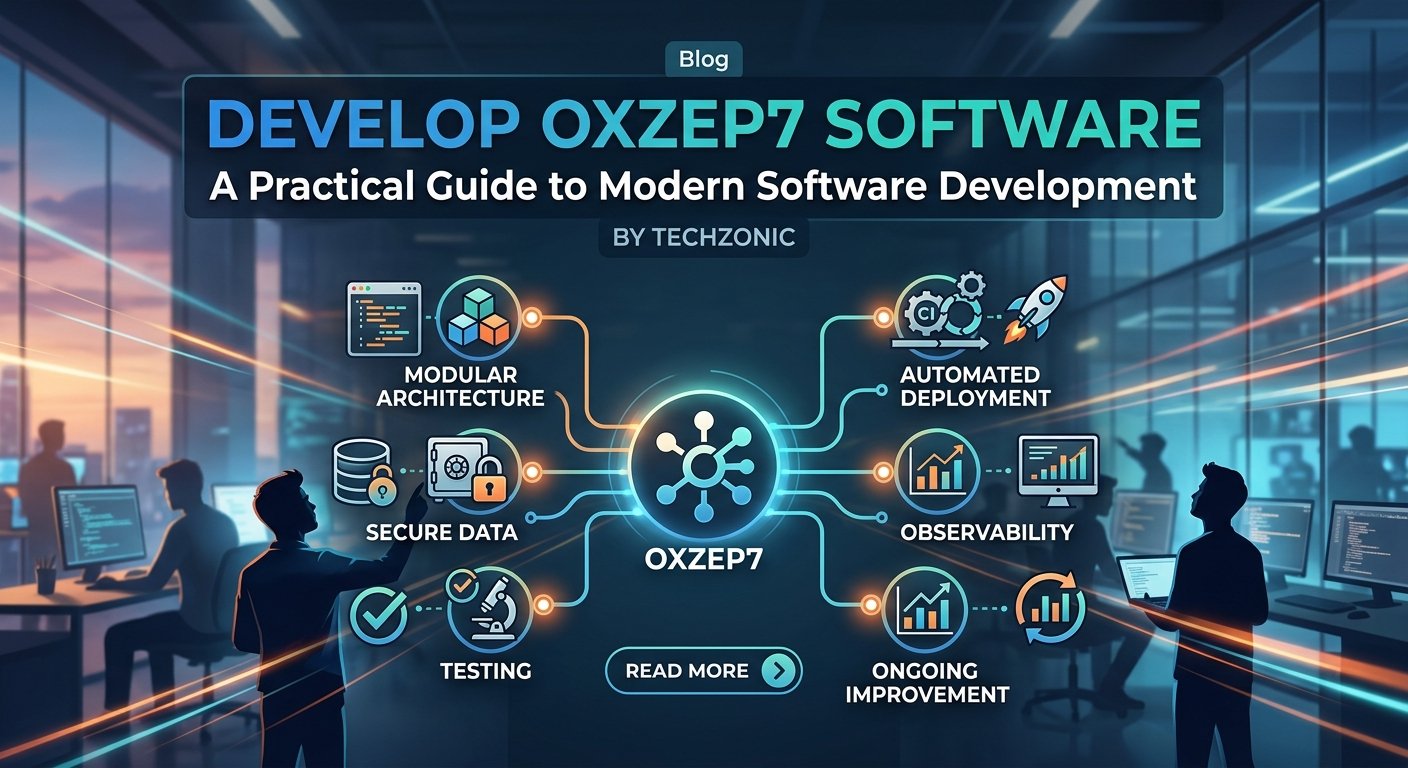
This guide explains how to approach an Oxzep7-style software project from the initial concept through architecture, development, security, testing, deployment, and ongoing improvement. The goal is not to pretend that an undocumented tool has capabilities that cannot be verified. Instead, the focus is on the engineering principles you can use to build a strong application under the Oxzep7 name or concept.
What Does Develop Oxzep7 Software Actually Mean?
The phrase develop oxzep7 software can mean different things depending on where you encountered it. Some online articles describe Oxzep7 as a modular framework, while others describe it more broadly as a development approach centered around flexible architecture and scalable applications.
Because there is no clearly established official specification that defines Oxzep7, developers should avoid treating every online claim as a technical fact. A better approach is to define the project yourself.
In practical terms, you can think of Oxzep7 software as a custom application designed around modular components, clearly separated responsibilities, reliable data flows, secure APIs, automated testing, and an architecture that can evolve as requirements change.
This interpretation is particularly useful for businesses and developers who want to build a flexible application without allowing the project to become a collection of tightly connected features.
The most important principle is simple: the name of the project matters less than the quality of its engineering. If you want to develop oxzep7 software, start with the problem you are solving rather than the technology you want to promote.
Why the Definition Matters
Software projects often fail because developers begin with tools instead of requirements. Choosing a programming language, database, or cloud provider before understanding the product can create unnecessary complexity.
A better process begins with the user’s problem. Once the problem is understood, the technical architecture can be selected around it.
This approach also makes the project easier to explain to clients, investors, developers, and future users. Instead of saying that the application uses a mysterious or fashionable technology, you can clearly describe what it does, how it works, and why the architecture was selected.
Planning Before You Develop Oxzep7 Software
Good planning is one of the biggest differences between a manageable software project and an expensive technical problem.
Before you develop oxzep7 software, define the application’s purpose in one or two clear sentences. Ask what the software should accomplish, who will use it, what information it will process, and what outcome should improve after implementation.
For example, imagine that the proposed application is an internal business automation platform. Its purpose might be to receive customer requests, validate information, assign tasks, track progress, and provide management reports.
That description immediately gives the development team something concrete to work with.
The next step is to separate essential functionality from future ideas. Your first release should solve the central problem without trying to become an enormous platform.
Establish Clear Product Requirements
Requirements should describe behavior rather than vague technical ambitions.
Instead of saying “the software should be advanced,” define what users must actually be able to do. Instead of saying “the system needs excellent performance,” establish measurable targets such as acceptable response time, expected concurrent users, and availability expectations.
A requirements document can describe authentication, user roles, data storage, workflows, reporting, notifications, integrations, administrative functions, and security requirements.
When you develop oxzep7 software with measurable requirements, technical decisions become much easier because the team has a common definition of success.
Choosing an Architecture for Oxzep7 Software
Architecture determines how the application behaves as it grows. A small prototype can sometimes survive with a simple structure, but production software needs clear boundaries.
A modular monolithic architecture can be an excellent starting point for many projects. It keeps deployment relatively simple while allowing the codebase to be separated into logical domains.
For larger systems, individual services may eventually be separated when there is a genuine operational reason to do so. Moving immediately to dozens of microservices, however, can create more problems than it solves.
The architecture selected to develop oxzep7 software should therefore match the actual complexity of the product rather than an imagined future scale.
A Practical Layered Model
A useful architecture can separate the presentation layer, application logic, domain logic, data access, integrations, and infrastructure.
The presentation layer handles what users see and how they interact with the application. The application layer coordinates use cases. Domain logic contains business rules. The data layer manages persistence. Integration components communicate with external systems, while infrastructure handles deployment and operational concerns.
This separation makes the application easier to understand because each area has a defined responsibility.
| Architecture Layer | Primary Responsibility | Example Concern |
| Presentation | User interaction | Forms, dashboards, navigation |
| Application | Coordinates workflows | Creating an order or processing a request |
| Domain | Business rules | Validation and decision logic |
| Data | Persistent information | Database queries and transactions |
| Integration | External communication | Payment or third-party APIs |
| Infrastructure | Runtime environment | Containers, servers, monitoring |
A structure like this gives developers room to change one part without unnecessarily rewriting everything else.
Selecting the Technology Stack
There is no single verified “Oxzep7 stack” that every developer must use. Any claim that one particular language or framework is officially required should be treated cautiously unless it can be traced to authoritative documentation.
When you develop oxzep7 software, select technologies according to the application’s requirements.
Python may be appropriate for automation, data processing, backend services, and applications where rapid development is valuable. JavaScript or TypeScript can be useful for modern web interfaces and full-stack applications. Java, C#, Go, Rust, PHP, and other languages can also be appropriate depending on performance, ecosystem, team expertise, and operational requirements.
The database should be selected in the same way. PostgreSQL may be an excellent choice for relational business applications, while other database models may make sense for specific workloads.
| Technical Area | Possible Choice | Why It May Fit |
| Backend | Python, TypeScript, Java, Go, C# | Depends on team and application requirements |
| Web interface | React, Vue, Angular, server-rendered UI | Depends on UX and project complexity |
| Database | PostgreSQL, MySQL, MongoDB | Depends on data model and workload |
| API | REST or GraphQL | Depends on integration requirements |
| Testing | Unit, integration, end-to-end tools | Protects functionality during changes |
| Deployment | Containers, virtual machines, managed platforms | Depends on operational needs |
| Version control | Git | Provides traceable source-code history |
The strongest technology stack is rarely the one with the most fashionable components. It is the one your team can maintain confidently.
Designing the Data Model
Data is often the foundation of the application. A poor data model can cause problems that become increasingly expensive to fix as the system grows.
To develop oxzep7 software effectively, identify the entities your application needs and the relationships between them.
For a customer-management application, entities could include customers, accounts, contacts, transactions, activities, permissions, and notifications.
Think carefully about ownership and relationships. Decide which information must be unique, which fields are mandatory, how records should be archived, and what happens when related data is deleted.
Security should also influence database design. Sensitive information should not be collected simply because the system technically can store it.
Data Validation and Integrity
Validation should occur at appropriate boundaries. A browser-side validation rule improves the user experience, but it should not be the only protection.
The server should validate incoming data independently. Database constraints can provide another layer of protection.
This layered approach is important when you develop oxzep7 software because external clients, scripts, integrations, and malicious users can bypass interface-level validation.
Reliable data is not simply a database concern. It is a system-wide responsibility.
Building the Application Logic
Business logic is where the software starts becoming genuinely useful.
Suppose the application needs to approve a customer request. The process may involve checking account status, validating submitted information, determining eligibility, recording the decision, and notifying another system.
Instead of putting all of this logic inside a controller or user-interface component, isolate the business rules into understandable services or domain modules.
This makes the system easier to test and easier to change.
When you develop oxzep7 software, keep business rules independent from presentation whenever practical. If a rule exists because of the business rather than because of a particular screen, it should generally not depend directly on that screen.
Make Workflows Explicit
Complex workflows should be visible in the architecture.
A workflow might move from “received” to “validated,” then “approved,” “processed,” and finally “completed.” Explicit states are easier to monitor than hidden conditions spread throughout unrelated functions.
This becomes particularly valuable when requirements change. If the business introduces a new approval stage, developers can modify the workflow rather than searching through hundreds of unrelated conditions.
Developing the API Layer
Modern software frequently depends on APIs. Even an application that begins as a single product may eventually need to communicate with mobile clients, reporting systems, payment providers, business tools, or partner platforms.
A good API should have predictable routes, consistent responses, meaningful error messages, authentication, authorization, validation, and appropriate documentation.
API versioning can also become important when external clients depend on your system.
If you develop oxzep7 software as an API-driven application, think of the API as a long-term contract. Changes should be introduced carefully because clients may depend on existing behavior.
API Security
Authentication answers who the user or system is. Authorization answers what that user or system is allowed to do.
These concepts should not be confused.
A user being successfully authenticated does not mean that they should have access to every resource.
Apply authorization rules at the server level, protect sensitive endpoints, validate input, use encrypted connections, and avoid exposing confidential information through error responses.
Creating a User-Friendly Interface
Technical quality means little if users cannot understand the product.
The interface should communicate what users can do, what has happened, and what they should do next.
Good UI design is not about adding more colors, animations, or visual effects. It is about reducing uncertainty.
Forms should provide useful validation feedback. Buttons should have clear actions. Error messages should explain problems without exposing sensitive implementation details.
When you develop oxzep7 software, usability testing should begin before the application is considered finished.
Even a small group of representative users can reveal confusing workflows that developers may never notice because they already understand how the system works.
Security Should Be Designed Into Oxzep7 Software
Security should not be a final-stage feature.
When you develop oxzep7 software, security needs to be considered during architecture, data modeling, API development, authentication, deployment, and maintenance.
Common concerns include insecure authentication, weak authorization, injection attacks, exposed credentials, unsafe file uploads, insufficient logging, insecure dependencies, and poorly configured infrastructure.
Secrets such as database passwords, API keys, and private credentials should not be committed directly into source code.
Access should follow the principle of least privilege. A component should have only the permissions it genuinely requires.
Privacy and Sensitive Information
If the application processes personal, financial, medical, employee, or otherwise sensitive information, requirements become more demanding.
The team should understand applicable privacy laws, contractual obligations, retention requirements, access controls, and breach-response procedures before production deployment.
Do not assume that adding encryption automatically makes a system compliant. Compliance involves processes, policies, controls, documentation, and ongoing management as well as technology.
Testing Before You Develop Oxzep7 Software for Production
Testing is where assumptions meet reality.
A serious project should use several levels of testing rather than relying entirely on manual browser checks.
Unit tests can verify individual functions and business rules. Integration tests can verify communication between components. End-to-end tests can simulate important user journeys.
Performance testing can reveal bottlenecks that are invisible during ordinary development.
When you develop oxzep7 software, prioritize tests around the most important business behavior first. A small number of meaningful tests is more valuable than hundreds of tests that provide little confidence.
| Testing Type | Main Purpose | Example |
| Unit testing | Verify individual logic | Validate eligibility rules |
| Integration testing | Verify component interaction | API-to-database workflow |
| End-to-end testing | Verify complete user journeys | Registration through account creation |
| Security testing | Identify vulnerabilities | Authorization checks |
| Performance testing | Measure behavior under load | Concurrent user simulation |
| Regression testing | Prevent old bugs from returning | Re-running critical scenarios |
Testing should continue throughout development rather than being postponed until the final week.
Deployment and Infrastructure
A successful development project eventually needs a reliable production environment.
Deployment may use cloud infrastructure, dedicated servers, containers, managed application platforms, or a combination of these options.
The correct choice depends on budget, performance requirements, operational expertise, compliance, and expected growth.
Containerization can help standardize environments, but it is not automatically necessary for every project. Similarly, Kubernetes can be valuable for certain operational requirements but may be excessive for a small application.
The best strategy to develop oxzep7 software is to introduce infrastructure complexity only when the project receives a corresponding benefit.
Continuous Integration and Delivery
Automated pipelines can build the application, run tests, check code quality, package releases, and deploy approved versions.
This reduces the chance that a developer will accidentally skip an important verification step.
A mature deployment process should also provide rollback capabilities. If a release causes unexpected problems, the team should have a controlled way to restore the previous stable version.
Monitoring and Maintenance After Launch
Launching software is not the end of development.
Real users will discover unusual scenarios, performance problems, confusing workflows, and requirements that were impossible to predict during planning.
Observability helps the team understand what is happening inside the application.
Useful signals include application errors, response times, resource consumption, failed requests, background-job failures, and important business events.
When you develop oxzep7 software, monitoring should be connected to meaningful operational goals rather than collecting enormous quantities of data without a purpose.
Improving the Product Over Time
Software should evolve through evidence.
User feedback, analytics, support requests, performance measurements, and security findings can all influence the roadmap.
A useful maintenance process separates urgent defects from valuable improvements and experimental ideas.
Technical debt should also be tracked. Ignoring architecture problems for too long can make future development slower and more expensive.
Common Mistakes to Avoid When You Develop Oxzep7 Software
One major mistake is treating an unverified technology label as a substitute for technical requirements. Because Oxzep7 does not currently have a clearly established official specification, developers should be especially careful about unsupported claims.
Another mistake is choosing an overly complicated architecture before the product has demonstrated a need for it.
Premature microservices, unnecessary infrastructure, excessive abstraction, and too many dependencies can slow development without providing meaningful value.
A third problem is neglecting security until launch. Retrofitting authentication, authorization, encryption, audit trails, and privacy controls can be considerably harder than incorporating them into the original architecture.
The final mistake is forgetting the users. A technically elegant application can still fail if it solves the wrong problem or makes ordinary tasks unnecessarily difficult.
My Opinion on Develop Oxzep7 Software
My opinion is that the most sensible way to develop oxzep7 software right now is to treat Oxzep7 as a project or architectural concept rather than pretending it is a mature, universally defined framework.
There are many online pages that confidently describe specific Oxzep7 commands, official layers, proprietary features, or fixed technology requirements. However, I would not build a production system around those claims without first finding authoritative documentation from the actual creator or organization behind the technology. Search results do not currently establish a clear official Oxzep7 ecosystem, and searches for an official GitHub or PyPI presence did not return a verifiable result.
For me, that does not mean the idea should be dismissed. It means the engineering process should be stronger than the label.
If a client asked me to develop oxzep7 software today, I would first define the product requirements, establish the intended architecture, select proven technologies, create a small working prototype, validate the riskiest assumptions, and only then expand toward a production system.
That approach is less exciting than claiming that an unknown framework can solve everything, but it is much more trustworthy.
How to Make an Oxzep7 Project Scalable
Scalability is not simply about adding more servers.
A scalable application has clear boundaries, efficient data access, controlled resource usage, asynchronous processing where appropriate, caching when justified, and an architecture that allows individual components to evolve.
Database indexing can dramatically improve response times for frequently queried information. Background workers can remove slow operations from user-facing requests. Caching can reduce unnecessary computation and database traffic.
However, optimization should be based on evidence.
When you develop oxzep7 software, measure the application before making major performance changes. A bottleneck identified through profiling is far easier to solve than a bottleneck that exists only in someone’s imagination.
The Future of Oxzep7-Style Development

The broader ideas associated with develop oxzep7 software—modularity, automation, scalable architecture, secure APIs, observability, and maintainable code—are likely to remain relevant regardless of what eventually happens to the Oxzep7 name.
Software development continues to move toward systems that integrate cloud services, automation, AI capabilities, data platforms, and increasingly sophisticated user experiences.
The challenge is maintaining engineering discipline while adopting these technologies.
Artificial intelligence can accelerate coding, documentation, testing, and analysis, but generated code still needs review. Cloud platforms can make infrastructure easier to provision, but they do not remove the need for security and cost management.
The strongest software teams will continue to combine automation with human judgment.
A Practical Development Roadmap
If your goal is to develop oxzep7 software as a genuine product, think of the project as a progression from uncertainty toward validated functionality.
Start by defining the user problem and measurable product goals. Establish the architecture before the codebase becomes large. Build a small proof of concept around the highest-risk technical assumption. Validate the data model and core workflow. Then create the minimum useful product.
After that, strengthen authentication, authorization, testing, monitoring, deployment, and documentation.
Only when the application demonstrates real usage should you invest heavily in advanced scaling strategies.
This approach controls both technical risk and financial risk. It also gives developers an opportunity to learn from real users before making expensive architectural commitments.
Final Thoughts on Develop Oxzep7 Software
To develop oxzep7 software successfully, focus on software engineering fundamentals rather than relying on vague claims about an undefined framework. At present, Oxzep7 does not appear to have a universally recognized official specification, so responsible developers should clearly distinguish verified information from interpretation.
A strong Oxzep7-style application can still be approached as a modular, maintainable, secure, and scalable software project. The foundation should include clear requirements, sensible architecture, a carefully selected technology stack, reliable data management, secure APIs, useful testing, controlled deployment, and continuous monitoring.
The most important lesson is that successful software is not created by a name, framework, or trend. It is created by solving a real problem with dependable engineering.
If you plan to develop oxzep7 software, start small, verify assumptions, document decisions, protect user data, test critical workflows, and improve the application using real evidence. That is a far more sustainable path than building around unverified technical promises.
Frequently Asked Questions About Develop Oxzep7 Software
What is Oxzep7 software?
Oxzep7 software is not currently backed by a clearly established, universally recognized technical specification. Online sources describe it in different ways, including as a custom framework concept and as an approach centered on modular, scalable software architecture. Because the terminology is inconsistent, developers should verify any specific technical claims before adopting them.
How can I develop oxzep7 software?
To develop oxzep7 software, begin with requirements and user needs, then design an appropriate architecture, select a suitable technology stack, build the core functionality, implement security, test the application, and establish reliable deployment and monitoring. The exact programming language should depend on the project’s requirements rather than an assumed official Oxzep7 stack.
Is Oxzep7 an official programming language or framework?
There is currently no clear authoritative evidence establishing Oxzep7 as a mainstream programming language or universally documented framework. Searches for an official package or repository do not provide a verified ecosystem comparable to established technologies. Developers should therefore be cautious with claims about official commands, features, or specifications.
Can businesses use an Oxzep7-style application?
Yes. Businesses can build custom applications using the architectural principles often associated with Oxzep7 discussions, such as modularity, strong validation, secure APIs, maintainability, and scalability. The important consideration is the application’s actual requirements, security needs, operational environment, and long-term maintenance strategy.
What technology should I use to develop oxzep7 software?
There is no verified universal technology stack required for Oxzep7. Python, JavaScript or TypeScript, Java, C#, Go, and other technologies can all be appropriate depending on the project. The best choice is the stack that meets performance, security, integration, budget, team-skill, and maintenance requirements and more.
