

Table of Contents
Searching for the tickets 2021 website for gamificationsummit can be confusing because the phrase looks like a direct request for an event ticket page, yet it may point to historical registration information rather than an active checkout. A page connected with a 2021 conference may have expired, changed ownership, moved to a new domain, or disappeared from search results. That makes it important to separate archived information from current ticket offers.
This guide explains how to interpret the search phrase, identify a legitimate historical event page, review ticket details, assess payment security, and avoid misleading sellers. It does not assume that every website using the phrase is an official source. In fact, several pages currently ranking for similar wording were published years after 2021, so their existence does not prove that they handled ticket sales for the original event.
The goal is to help readers understand what the tickets 2021 website for gamificationsummit may represent and how to research it responsibly. Whether you are checking an old purchase, looking for a past agenda, studying event marketing, or trying to confirm a historical registration record, the same principles of verification apply.
Understanding the Tickets 2021 Website for GamificationSummit Search
The keyword combines four separate ideas: tickets, the year 2021, a website, and a Gamification Summit. This usually signals mixed search intent. Some visitors may want a purchase page, while others may be trying to locate an old event schedule, recover a confirmation email, confirm the organizer, or learn how registration worked.
The phrase should therefore not be treated as proof that one specific official page still exists. Search results can contain newly created articles that repeat an old keyword without providing primary evidence. A responsible reader should look for organizer names, historical dates, archived page captures, speaker announcements, venue details, and ticket terms that were published close to the event period.
| Search intention | What the visitor may actually need | Best verification method |
| Historical ticket purchase | An old registration or checkout page | Archived organizer website |
| Event confirmation | Date, venue, speaker, or agenda details | Original announcements and archived pages |
| Payment record | Receipt, invoice, or ticket email | Email search and payment statement |
| Research purpose | Information about event marketing or ticket design | Archived landing pages and contemporary coverage |
| Current attendance | A new summit or future event | Current organizer website only |
When researching the tickets 2021 website for gamificationsummit, the safest starting point is the event organizer rather than a random article that merely mentions the keyword. If the original domain is known, an archived snapshot can provide a more reliable picture of what the page displayed during 2021.
Why People Still Search for a 2021 Gamification Summit Ticket Page
Historical event pages continue to attract searches for several reasons. A former attendee may need evidence of participation for an employer, university, professional portfolio, or tax record. A researcher may want to compare ticket packages, sponsorship models, or virtual conference features used during the pandemic period. An event organizer may also be studying how earlier summits presented agendas, workshops, and access levels.
Another possibility is that the searcher encountered an old bookmark, invoice description, social post, or browser history entry. In that situation, the tickets 2021 website for gamificationsummit becomes a navigational query. The person is not necessarily trying to buy a ticket now; they may simply want to recover a page that once existed.
Historical searches require more care than ordinary event searches. A modern page can use the same wording while discussing ticketing in general. Publication date matters, as does the date of the underlying event. A page created in 2025 or 2026 cannot automatically be treated as a contemporary source for a 2021 checkout process.
Historical Context Behind Gamification Summits
Gamification generally refers to the use of game-design elements in non-game settings to encourage participation, motivation, learning, or engagement. Common examples include points, progress indicators, challenges, badges, rewards, and feedback systems.
The concept became a major business and academic topic during the early 2010s. Research literature connects the first widely cited Gamification Summit with 2011 rather than 2021.
That distinction matters. The wording tickets 2021 website for gamificationsummit may refer to a later event, an archive category, a mislabeled page, or a keyword variation rather than the original summit series. Without a primary organizer record, it would be inaccurate to invent a 2021 venue, speaker lineup, ticket price, or conference schedule.
A trustworthy article should acknowledge this uncertainty instead of hiding it. Search engines often group similar phrases, and website owners sometimes publish content around terms that users type even when the historical record is incomplete.
Readers should therefore view the keyword as a research starting point rather than a verified event identity. Any specific claim about the conference should ideally be supported by an archived organizer page or another source published close to the proposed event date.
How to Identify the Original Event Website
The strongest evidence normally comes from a domain controlled by the organizer at the time of the event. Look for consistent branding, legal business information, speaker biographies, sponsor logos, venue details, privacy terms, refund conditions, and contact information that match other contemporary records.
A real historical ticket page usually connects naturally with the rest of the event website. The agenda, ticket tiers, checkout, confirmation process, and organizer details should feel like parts of one system.
A page that contains only repeated keywords, vague promises, or generic statements about securing access may be informational content rather than an authentic ticket sales page.
| Verification signal | Strong evidence | Weak evidence |
| Publication timing | Page or archive capture from 2021 | Article published several years later |
| Organizer identity | Named company with matching contact details | No legal name or ownership information |
| Event specifics | Exact date, venue, agenda, and speakers | Broad claims with no confirmable details |
| Ticket process | Clear checkout terms and confirmation method | Unexplained payment request |
| External consistency | Matching announcements from speakers or partners | Isolated page with no supporting references |
For the tickets 2021 website for gamificationsummit, an archived version of the organizer’s domain is more valuable than a recently published summary. The Internet Archive’s Wayback Machine allows users to search archived websites by URL and select captures from a particular year and date.
What a Trustworthy Ticket Page Should Contain
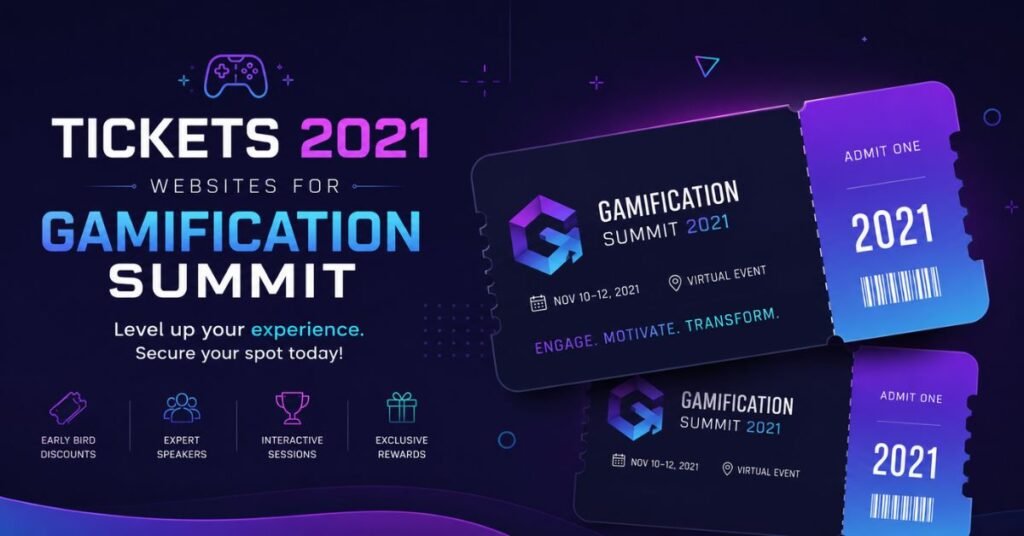
A reliable ticket page should answer practical questions before requesting payment. The event name, date, time zone, venue or streaming platform, ticket inclusions, taxes, service charges, refund rules, transfer policy, and organizer contact details should be visible in plain language.
The page should also clarify whether the pass covers live attendance, recorded sessions, workshops, networking areas, downloadable resources, certificates, or post-event access.
In 2021, many conferences used virtual or hybrid formats, so time zones and streaming requirements were especially important. However, those details should be verified for the specific event rather than assumed.
When evaluating a page related to the tickets 2021 website for gamificationsummit, pay close attention to consistency. The event name on the checkout screen should match the landing page. The organizer shown on the receipt should match the company described in the terms.
The currency and total cost should be displayed before the buyer submits payment. Any taxes, processing fees, booking charges, or platform fees should also be explained before the final confirmation.
Trust is built through clarity. A professional event website does not force visitors to guess what they are buying, how long access will last, or who will handle their personal information.
Possible Ticket Types and Access Models
Without a verified historical ticket page, exact ticket categories should not be presented as facts. Still, event websites commonly use several access models, and understanding them can help a reader interpret an archived registration page.
| Possible access model | Typical purpose | Details that should be confirmed |
| General admission | Main talks and standard sessions | Dates, session access, and replay availability |
| Workshop pass | Smaller practical or specialist sessions | Capacity, prerequisites, and materials |
| VIP or premium pass | Added networking or exclusive content | Exact benefits and access limitations |
| Virtual ticket | Online livestream or recordings | Platform, time zone, device needs, and expiry |
| Group or corporate pass | Multiple attendees from one organization | Seat count, transfer rules, and invoicing |
These categories are examples, not confirmed packages for the tickets 2021 website for gamificationsummit. A trustworthy historical guide should never replace missing evidence with confident-sounding prices, benefits, or promotional claims.
The best approach is to compare any archived ticket label with the archived agenda and terms page from the same date. If a premium ticket promised a workshop, the workshop should appear elsewhere on the event website.
If a virtual pass included recordings, the access period should have been explained. The page should also clarify whether recordings could be downloaded or only viewed through a protected platform.
Payment Security and Personal Data Protection
A ticket website handles sensitive information, including names, email addresses, billing details, and sometimes payment-card data. Secure processing is therefore more important than attractive design.
The PCI Security Standards Council states that PCI DSS applies to organizations that store, process, or transmit cardholder data. The standards contain technical and operational requirements intended to protect payment information.
For a historical page, the presence of HTTPS alone is not enough to prove legitimacy. A secure connection may protect information while it is being transmitted, but it does not confirm that the seller has permission to sell tickets.
The buyer should also verify the organizer, payment processor, checkout domain, privacy policy, and final amount. A legitimate payment processor should appear naturally within the event’s registration process rather than through an unexplained link sent by an unknown person.
The tickets 2021 website for gamificationsummit may now be inactive, redirected, or controlled by a different owner. That means an old-looking page should not be trusted merely because its design resembles a conference website.
Domain ownership and page content can change over time. A website that was legitimate in 2021 may no longer be controlled by the same organization today.
Payment details should never be entered into an archived page. Web archives are useful for research and verification, not for completing transactions. Any current purchase should take place through a present-day organizer channel whose authenticity has been independently confirmed.
Refund, Cancellation, and Ticket Transfer Policies
Refund terms are a major part of any event purchase. A strong ticket page explains what happens if the event is canceled, postponed, moved online, rescheduled, or changed substantially.
It should also state whether the ticket can be transferred to another attendee and whether processing or service fees are refundable.
For an event associated with 2021, policy wording may have been especially detailed because conferences were dealing with travel restrictions, public health requirements, and changes between physical and virtual formats. Still, readers should avoid assuming that every event followed the same policy.
When reviewing the tickets 2021 website for gamificationsummit, look for the version of the terms that was active when the ticket was purchased. A current refund policy may be different from the historical policy.
Archived terms, confirmation emails, invoices, and payment statements can help establish what applied at the time. The purchase date may also matter because some refund deadlines are calculated from the original transaction or event date.
A vague promise such as refunds being available when appropriate is less useful than a policy that provides deadlines, conditions, processing methods, and contact details. Good event administration reduces uncertainty before payment instead of resolving every issue after a dispute begins.
Virtual and Hybrid Attendance Considerations
A virtual ticket is more than a video link. It may include account creation, identity verification, livestream access, chat features, downloadable files, networking rooms, session recordings, and technical support.
Each feature can have its own access period and device requirements. Some sessions may be available live only, while others may remain accessible for several days or weeks.
If the tickets 2021 website for gamificationsummit offered digital attendance, the historical page should ideally explain the supported browser, login process, time zone, replay window, and method for receiving access instructions.
A confirmation email might also name the streaming platform, provide a personal login link, or explain when the final schedule would be released.
Accessibility is another important consideration. W3C’s Web Content Accessibility Guidelines address areas such as text alternatives, keyboard accessibility, understandable forms, and clear feedback. Accessible registration forms benefit users with visual, motor, cognitive, and other disabilities while improving usability for a wider audience.
A ticket page that is difficult to navigate, unclear on mobile, or dependent on unlabeled visual controls can create barriers before the event even begins. Good gamification should increase engagement without making essential registration tasks harder.
Using Web Archives to Research the 2021 Page
Web archives are often the most practical tool for investigating a missing event page. The Wayback Machine preserves snapshots of many websites and lets users search by URL, year, date, and capture time.
Not every page is archived, and dynamic checkout screens may not function. However, saved landing pages can still reveal useful historical details, including event dates, speaker names, ticket descriptions, partner logos, registration deadlines, and organizer information.
To research the tickets 2021 website for gamificationsummit, begin with the most likely original domain. Examine captures from several dates around the proposed event period.
Compare the homepage, agenda, ticket page, speakers, terms, and contact page. One isolated snapshot may be incomplete, while several consistent captures can provide stronger evidence.
Archived pages should be read as historical records rather than live services. Buttons may fail, images may be missing, and embedded scripts may not load.
A missing checkout does not necessarily mean that ticket sales never existed. It may simply mean that the payment platform blocked archiving, required a login, used scripts that could not be captured, or operated on a separate domain.
The strongest conclusion comes from multiple matching sources, such as an archived event page, a speaker announcement, an organizer email, and a payment receipt.
Warning Signs of Misleading or Unsafe Ticket Pages

Ticket fraud often relies on urgency, imitation branding, and payment methods that are difficult to reverse. The FTC has warned that scammers may use paid search results and social media to direct users toward fraudulent websites. Appearing near the top of a search page should therefore not be treated as proof of authenticity.
| Warning sign | Why it matters | Safer response |
| No organizer identity | The seller cannot be properly verified | Find the organizer through independent sources |
| Unrealistic urgency | Pressure can prevent careful checking | Pause and verify before paying |
| Payment by gift card or cryptocurrency only | Recovering the payment may be difficult | Use a protected and traceable payment method |
| Mismatched domain | The checkout may not belong to the event | Confirm the processor through the organizer |
| No refund or privacy terms | Buyer rights and data use are unclear | Do not submit personal or payment information |
| Screenshot-only ticket | It may be duplicated, canceled, or fake | Confirm delivery through the official system |
A page targeting the phrase tickets 2021 website for gamificationsummit should not be trusted solely because it repeats the event name many times. Keyword usage is not proof of authorization.
Authenticity comes from verifiable ownership, consistent records, clear terms, and a legitimate purchase path. The domain should also have a reasonable history that matches the identity of the event organizer.
Unusual spelling, copied speaker profiles, missing social accounts, incomplete contact details, and unsupported countdown timers can also indicate a low-quality or misleading website.
Recovering an Old Ticket or Registration Confirmation
Former attendees may search for the tickets 2021 website for gamificationsummit because they need a copy of an old ticket. In that situation, searching for the original website may not be the quickest solution.
The confirmation email may contain the attendee name, order number, event date, ticket category, payment amount, and registration platform. Searching an email account for terms such as Gamification Summit, ticket confirmation, registration, receipt, invoice, attendee, or order can help locate the record.
A bank or card statement may reveal the billing name used by the organizer or ticketing provider. That name may differ from the public event name, so comparing the transaction date with old emails can be helpful.
A calendar entry may also contain an event link, meeting invitation, venue address, or digital access instructions. If the attendee registered through an employer, the company’s finance, human resources, or learning department may still have an invoice.
When contacting an organizer, provide the approximate purchase date, attendee name, email address used during registration, and any available order reference. Full payment-card details should never be sent through ordinary email.
How an Effective Gamification Summit Ticket Website Should Be Designed
From an organizer’s perspective, the ticket website should make the decision process simple. Visitors should immediately understand what the event is, who it is for, when it takes place, how attendance works, and what each ticket includes.
Gamification can enhance the experience when it supports a meaningful goal. A progress indicator can show how much of the registration form remains. Personalized recommendations can guide visitors toward relevant sessions.
A completed-profile badge can encourage attendees to prepare for networking. A session planner can help visitors build a useful agenda before the conference begins.
These features should never conceal prices, manipulate users, or create unnecessary barriers. Essential information must remain available even to users who do not participate in optional challenges or engagement features.
An effective version of the tickets 2021 website for gamificationsummit would have balanced engagement with transparency. The event theme and visual identity could create excitement, while the checkout remained direct and predictable.
Essential actions such as reviewing the total cost, reading refund terms, correcting form errors, and downloading a receipt should remain easy.
Performance also matters. A slow or unstable checkout can lead to abandoned purchases and duplicate payment attempts. Mobile responsiveness, readable text, clear buttons, and useful error messages are central parts of the ticket-buying experience.
The Role of Gamification in Event Registration
Gamification can be used before, during, and after an event. Before the event, attendees may receive points for completing profiles, choosing sessions, introducing themselves, or inviting colleagues.
During the summit, challenges may encourage participation in workshops, exhibitor visits, question-and-answer sessions, or networking activities. Afterward, progress systems may motivate attendees to watch recordings, complete assessments, or download resources.
However, gamification should serve the attendee rather than distract from the conference. A complicated reward system can make registration feel like work, particularly when visitors simply want to purchase a ticket.
The tickets 2021 website for gamificationsummit would have been more effective if any gamified feature had been optional, understandable, and connected to a genuine attendee benefit.
Rewards should also be described honestly. A badge, discount, certificate, or prize should have clear eligibility rules. Organizers should avoid designs that create false scarcity or encourage visitors to make rushed purchases.
Ethical gamification improves motivation while preserving informed choice. It should never hide mandatory fees, make cancellation unnecessarily difficult, or pressure users through misleading progress messages.
Mobile Experience and Registration Usability
Many users discover events through social media, email newsletters, messaging apps, or mobile search. A ticket page must therefore work properly on a small screen.
The event name, date, ticket price, main benefits, and registration button should be easy to see without excessive scrolling. Forms should use clearly labeled fields and display helpful error messages when information is missing.
The tickets 2021 website for gamificationsummit may have attracted international attendees, making mobile accessibility especially important. Visitors from different regions may have used different devices, payment methods, date formats, currencies, and internet speeds.
A good registration page should explain the required date format, supported payment options, and billing currency. It should also avoid resetting the entire form when one field contains an error.
The checkout should not depend on tiny buttons, hover effects, or visual elements that cannot be accessed through a keyboard or screen reader. Important terms should be available as readable text rather than only inside images.
A usable registration system reduces frustration and gives buyers greater confidence that their ticket has been processed correctly.
Search Intent and SEO Value of the Keyword
The keyword has informational, navigational, and possible transactional intent. A searcher may want to understand the event, locate a particular historical page, or find a legitimate way to purchase access.
Because the year is 2021, however, the transactional intent is likely historical unless the event uses the date as part of an archive label.
An SEO article targeting tickets 2021 website for gamificationsummit should answer the query directly while avoiding false certainty. It should explain what can be verified, what remains unclear, and how readers can locate primary evidence.
Repeating the keyword without providing those answers creates a poor user experience and weakens trust.
Semantic relevance can be improved through related concepts such as Gamification Summit registration, historical event tickets, archived conference website, virtual summit access, ticket verification, secure online checkout, refund policy, attendee confirmation, and event registration platform.
Google recommends creating helpful, reliable, people-first content rather than material produced mainly to manipulate rankings. Its guidance explains that E-E-A-T relates to experience, expertise, authoritativeness, and trustworthiness, with trust being especially important.
For this topic, those principles are best demonstrated through careful sourcing, clear limitations, practical guidance, and the avoidance of invented event details.
Content Accuracy and the Importance of Primary Sources
Historical event content can easily become inaccurate when one article copies another. A price, date, speaker name, or ticket benefit may be repeated across multiple websites even when the original source is unclear.
The number of pages repeating a claim does not necessarily make the claim correct. Several pages may have copied the information from the same unverified source.
When writing about the tickets 2021 website for gamificationsummit, primary evidence should be given greater weight than recent summaries. An archived organizer page, original event announcement, confirmed speaker post, venue calendar, ticket receipt, or registration email is more valuable than a generic article published years later.
The publication date and event date should be treated separately. A page published in 2026 may discuss a 2021 event accurately, but it must show where the historical information came from.
Writers should clearly label estimates, examples, and unconfirmed interpretations. This approach does not weaken an article. It increases credibility because readers can understand which details are established and which require further verification.
My Opinion on the Tickets 2021 Website for GamificationSummit

In my opinion, the most important issue with this keyword is not the ticket price or event hype. It is verification.
The phrase sounds highly specific, but the available search landscape does not provide enough reliable evidence to confidently name one original 2021 seller, exact ticket package, venue, or official event schedule.
I would treat any modern page about the tickets 2021 website for gamificationsummit as a secondary source unless it links to a genuine archived organizer page or provides verifiable records from 2021.
This is especially important when the page was published several years after the date mentioned in the keyword. A recent article may be useful as a general guide, but it should not automatically be treated as historical proof.
A useful article should protect the reader from confusion rather than add to it. It is better to say that a detail is unconfirmed than to create a polished but fictional answer.
Historical event research can still be valuable, but it should be based on archived evidence, original emails, receipts, and consistent organizer information.
Conclusion
The tickets 2021 website for gamificationsummit is best understood as a historical or navigational search query. It may lead users toward an old registration page, archived event details, ticket confirmation records, or general information about Gamification Summit ticketing.
Because current search results include pages published long after 2021, readers should not assume that every ranking page is an official historical source.
The safest research process begins with the organizer’s original domain, archived captures from the relevant period, matching speaker or partner announcements, and personal records such as confirmation emails and payment statements.
A legitimate ticket page should clearly explain the event date, access type, full cost, refund terms, data handling, and organizer identity.
Most importantly, an archived page should never be used as a live checkout. The tickets 2021 website for gamificationsummit can be studied for historical information, but any present-day purchase must be completed through a verified current organizer channel.
Accuracy, payment safety, and transparent evidence matter more than keyword repetition or attractive event branding.
Frequently Asked Questions
What is the tickets 2021 website for gamificationsummit?
The phrase most likely refers to a historical ticket or registration page connected with a Gamification Summit in or around 2021. However, the exact original page is not clearly established by the currently available search results, so readers should verify it through archived organizer records.
Can I still buy a 2021 Gamification Summit ticket?
A ticket for an event held in 2021 would normally no longer be available as active admission. A current page using the old phrase may provide historical information, recordings, or general ticketing content, but it should not be assumed to sell valid access to a past event.
How can I find the original 2021 ticket page?
Start with the organizer’s known domain and search it through the Internet Archive’s Wayback Machine. Review captures from 2021 and compare the ticket page with the archived homepage, agenda, speakers, contact details, and terms.
How do I know whether a Gamification Summit ticket website is legitimate?
Confirm the organizer’s legal identity, event date, contact information, ticket inclusions, refund policy, checkout domain, and payment processor. Look for matching records from speakers, sponsors, venues, or partner organizations, and avoid sellers that rely on pressure or unclear payment methods.
Is it safe to enter payment details on an archived ticket page?
No. Archived pages are intended for historical viewing and research, not live transactions. Payment should only be made through a verified current website controlled by the legitimate event organizer or its authorized ticketing provider and more.
