

Table of Contents
Asia’s financial technology market is moving through a period of practical transformation. The conversation is no longer limited to whether mobile banking, artificial intelligence, instant payments, tokenisation, and digital identity will influence finance. The more useful question is how quickly these technologies will become part of everyday banking, business payments, lending, investing, and regulatory supervision.
The search phrase fintechasia ftasiaeconomy tech updates reflects this wider interest. Readers using it are usually looking for a clear view of financial technology developments across Asia, along with the economic forces, regulatory decisions, and market risks shaping those developments. In that sense, the phrase works as an information category connecting fintech news with the broader Asian economy.
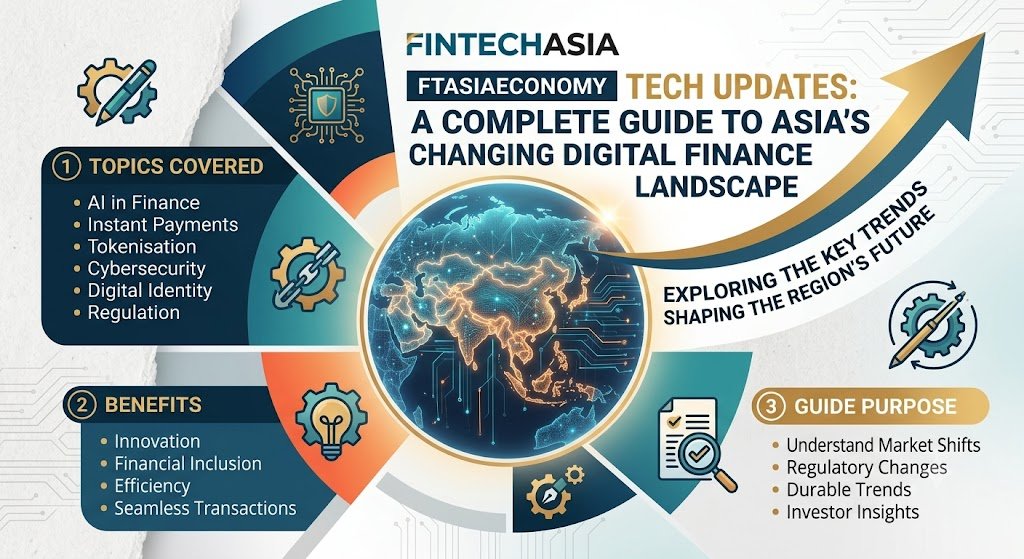
This guide explains the major themes behind these updates, why they matter, and how businesses, investors, finance professionals, and ordinary users can interpret them. It focuses on durable trends rather than short-lived headlines while recognising that the direction of digital finance can change as regulations, infrastructure, customer behaviour, and security threats evolve.
What FintechAsia FTAsiaEconomy Tech Updates Really Means
The phrase fintechasia ftasiaeconomy tech updates is best understood as a combined search topic rather than the name of one financial product. It brings together news and analysis involving Asian fintech companies, banking technology, digital payments, artificial intelligence, blockchain, cybersecurity, financial regulation, market conditions, and economic development.
FintechAsia presents FTAsiaEconomy-related coverage as a mix of economic reporting, market shifts, regulatory developments, funding movements, and core technology trends. This positioning suggests that readers are not only searching for startup news. They also want to understand how technology interacts with interest rates, business confidence, consumer spending, financial inclusion, and government policy.
This broader meaning is important for search intent. Some readers arrive with informational intent because they want explanations. Others have navigational intent because they are trying to find a specific FintechAsia or FTAsiaEconomy page. A smaller group may have commercial or transactional intent, such as evaluating fintech software, payment platforms, investment opportunities, or market-entry strategies.
Why Asia Has Become Central to the Fintech Story
Asia is not one uniform market. It includes highly developed financial centres, fast-growing emerging economies, large underbanked populations, digitally advanced consumers, and countries where cash remains important. That variety creates a strong testing ground for financial technology.
The value of fintechasia ftasiaeconomy tech updates comes from connecting these different conditions. A payment innovation that succeeds in Singapore may depend on strong regulation and infrastructure, while a lending application in Indonesia, Pakistan, India, or the Philippines may succeed because it reaches customers with limited access to traditional banking.
The region’s scale also matters. Financial institutions can serve large populations through mobile-first products, while governments can use digital public infrastructure to expand access to payments and financial services. At the same time, uneven internet access, limited financial literacy, fragmented regulation, and fraud risks can slow adoption.
The most useful technology updates therefore explain both opportunity and limitation. Presenting every new tool as automatically successful can mislead readers. A promising technology must still work within local regulations, consumer expectations, infrastructure conditions, and economic realities.
The Main Technology Areas Shaping Asian Finance
Readers following fintechasia ftasiaeconomy tech updates will repeatedly encounter a group of connected technologies. Each area influences a different part of the financial system, but its real impact often appears when multiple technologies are combined.
| Technology area | Main financial use | Potential advantage | Main concern |
| Artificial intelligence | Fraud detection, underwriting, service automation, and research | Faster analysis and lower operating costs | Bias, opacity, inaccurate output, and model risk |
| Instant payments | Domestic and cross-border transfers | Speed, convenience, and lower transaction friction | Fraud, operational resilience, and interoperability |
| Tokenisation | Digital representation of financial assets | Faster settlement and programmable transactions | Legal uncertainty, liquidity risk, and platform dependency |
| Open banking and APIs | Secure data sharing between providers | Competition and personalised products | Consent, privacy, and cybersecurity |
| Digital identity and eKYC | Remote verification and onboarding | Wider access and faster account opening | Identity theft and data misuse |
| Cloud infrastructure | Scalable banking and fintech operations | Flexibility and reduced infrastructure burden | Concentration and third-party risk |
| Regulatory technology | Automated compliance and monitoring | More efficient reporting and supervision | Poor data quality and false confidence |
The table shows why a single headline rarely tells the entire story. Faster payments require stronger fraud controls. AI-powered lending requires explainability and fair decision-making. Tokenised assets require legal clarity, reliable settlement arrangements, and confidence in the underlying claim.
Good analysis examines the technology, business model, customer impact, and risk framework together. It also considers whether the innovation has moved beyond a pilot programme and become reliable enough for widespread commercial use.
Artificial Intelligence Is Moving From Experiment to Infrastructure

Artificial intelligence has become one of the most visible subjects within fintechasia ftasiaeconomy tech updates. Banks and fintech firms are using AI for customer support, fraud monitoring, document review, credit assessment, risk analysis, coding assistance, and internal research.
Generative AI has expanded the range of possible applications because it can process and produce text, summarise documents, support employee workflows, and interact with customers through conversational systems. It may also help financial institutions examine large amounts of unstructured information more quickly.
The regulatory conversation is becoming more serious as adoption grows. The Monetary Authority of Singapore has proposed guidelines on AI risk management for financial institutions and has worked with industry participants on practical AI risk-management tools.
The Hong Kong Monetary Authority has also supported responsible adoption through industry reports, controlled testing environments, and generative AI sandbox programmes. These developments show that AI governance is shifting from broad ethical discussion towards practical controls, testing, accountability, documentation, and supervision.
The most successful financial AI systems will probably not be those that simply produce impressive demonstrations. They will be the systems that fit safely into real workflows, use reliable data, provide meaningful review mechanisms, and remain understandable to the people responsible for final decisions.
What Responsible AI Adoption Looks Like
Responsible adoption means that a financial institution should know what an AI model is doing, where its data comes from, how its output is checked, and who is accountable when something goes wrong.
It also means testing for unfair bias, protecting confidential information, monitoring model performance, and maintaining human review for important decisions. A model should not be trusted only because it produces fast or convincing answers.
This is especially relevant when fintechasia ftasiaeconomy tech updates covers AI-based credit scoring. A faster loan decision may improve the customer experience, but speed alone does not prove fairness or accuracy.
A lender still needs to understand whether its model disadvantages certain applicants, reacts poorly during economic shocks, or relies on personal information that customers did not expect to be used. Clear explanations and meaningful appeal procedures may become increasingly important as automated decision-making expands.
Instant Payments Are Becoming a Regional Infrastructure Issue
Instant payment systems have already changed domestic money transfers in many Asian markets. The next stage involves cross-border connectivity. This is a major theme in fintechasia ftasiaeconomy tech updates because trade, tourism, migrant remittances, e-commerce, and small-business payments can all suffer when international transfers are slow, expensive, or difficult to track.
The Bank for International Settlements’ Project Nexus is designed to standardise how domestic instant payment systems connect. Its blueprint was developed through cooperation involving Indonesia, Malaysia, Singapore, the Philippines, and Thailand, while India later joined the work towards live implementation.
The objective is to reduce the need for a separate custom connection between every pair of national payment systems. A standardised network could make cross-border instant payments easier to expand across additional countries.
This development matters because payment infrastructure can shape competition. When transfers become easier and more interoperable, smaller providers may gain access to customers and payment corridors that were previously difficult to serve.
Regional payment links still require common technical standards, effective foreign-exchange arrangements, consumer protection, fraud controls, dispute-handling processes, and cooperation between regulators. Speed cannot be treated as the only measure of success.
Digital Public Infrastructure and Financial Inclusion
Financial inclusion is often discussed as a social objective, but it is also an economic and technology issue. The usefulness of fintechasia ftasiaeconomy tech updates increases when coverage explains whether new systems are reaching people outside major cities, serving small merchants, supporting feature-phone users, and helping smaller businesses access formal financial services.
India’s digital-payment ecosystem illustrates how public infrastructure can support numerous financial services. The Reserve Bank of India has highlighted continued efforts to deepen access to digital payments, including UPI, RuPay, mobile banking, and other payment methods.
It has also documented features intended to widen usability, including UPI123Pay for feature-phone users and UPI Lite for smaller transactions. These services show how payment technology can be adapted to different devices, income levels, and customer needs rather than being designed only for premium smartphone users.
However, access is not the same as meaningful inclusion. A person may have a digital account but avoid using it because of poor connectivity, confusing interfaces, limited financial literacy, fear of scams, or inadequate customer support.
Real inclusion requires affordable services, clear language, accessible design, reliable identification systems, and practical consumer education. It also requires a fair method of resolving complaints when a transaction fails or fraud occurs.
Open Banking, APIs, and the Shift Towards Connected Finance
Open banking enables customers, with appropriate permission, to share financial information with authorised service providers. Application programming interfaces, commonly known as APIs, make that exchange possible by helping separate systems communicate in a structured manner.
This area appears frequently in fintechasia ftasiaeconomy tech updates because it can change how people compare products, manage money, apply for credit, receive financial advice, and access business services.
Hong Kong’s work on open APIs and its Commercial Data Interchange shows how regulators are encouraging more connected financial infrastructure. The Commercial Data Interchange was created to strengthen data infrastructure and support the development of new financial products.
Commercial information shared through secure channels may help financial institutions understand smaller businesses more efficiently. This can potentially improve lending assessments for companies that have limited physical assets but possess credible transaction or operational records.
The commercial promise is significant, but trust will determine adoption. Customers need to know what information is being shared, why it is required, which organisation will receive it, how long permission will remain active, and how access can be withdrawn.
Financial institutions and technology providers also need strong authentication, encryption, access controls, audit records, and procedures for managing third-party security failures.
Tokenisation Is Expanding Beyond Cryptocurrency Headlines
Tokenisation refers to representing an asset or financial claim in digital form, often through distributed-ledger technology. Unlike speculative cryptocurrency coverage, tokenisation discussions increasingly focus on bonds, deposits, investment funds, collateral, trade finance, and settlement infrastructure.
This makes tokenisation an important part of fintechasia ftasiaeconomy tech updates. The technology may reduce reconciliation work, shorten transaction chains, and support programmable transactions in which predefined conditions can be executed automatically.
Hong Kong’s newer fintech strategy has placed tokenisation among its strategic priorities. The Bank for International Settlements has also described potential efficiency gains involving trading, settlement, collateral management, and cross-border financial activity.
The opportunity should not hide the risk. A digital token is only as trustworthy as the legal rights, real assets, institutions, and systems supporting it.
Questions involving ownership, redemption, asset custody, settlement finality, liquidity, operational resilience, and jurisdiction remain essential. Tokenisation can modernise financial infrastructure, but it does not remove the need for sound financial management or legal certainty.
Cybersecurity and Fraud Are Now Core Product Issues
Security can no longer be treated as the private responsibility of a technical department. In digital finance, security is part of product design, customer experience, regulatory compliance, and brand trust.
Any serious reading of fintechasia ftasiaeconomy tech updates should therefore pay close attention to fraud patterns, identity controls, data protection, system outages, and third-party dependencies.
As digital payments grow, criminals increasingly target human users as well as financial institutions. Social engineering, account takeover, impersonation, malicious links, and authorised-payment scams can bypass technically secure systems by persuading customers to approve harmful actions.
Recent Asian financial-industry discussions have placed greater emphasis on electronic identity verification, anti-money-laundering controls, and customer-focused scam prevention.
Artificial intelligence adds another layer. It can improve fraud detection by identifying unusual behaviour, but it can also strengthen criminal tactics through convincing messages, synthetic identities, automated impersonation, and large-scale attacks.
Financial firms therefore need layered protection that combines secure technology, transaction monitoring, customer warnings, staff training, rapid incident response, and fair complaint handling.
Regulation Is Becoming More Technology-Specific
Early fintech regulation frequently focused on licensing broad categories of payment, lending, or digital-asset activity. Newer regulatory approaches are becoming more specific about AI governance, cloud dependence, operational resilience, data usage, tokenisation, cybersecurity, and customer outcomes.
That shift is central to fintechasia ftasiaeconomy tech updates because regulation can determine whether a technology scales, stalls, or changes direction. Regulators want to encourage useful innovation, but they must also protect customers and financial stability.
The difficult task involves producing rules that are clear enough to reduce uncertainty without becoming so rigid that they block responsible experimentation.
| Regulatory priority | What authorities are trying to achieve | What firms should prepare |
| AI governance | Accountable and explainable model use | Model inventories, testing, documentation, and human oversight |
| Cyber resilience | Continuity during attacks and system outages | Incident plans, recovery testing, and vendor controls |
| Consumer protection | Fair products and transparent communication | Clear disclosures, complaint handling, and suitability checks |
| Data governance | Lawful and secure use of information | Consent controls, access management, and retention policies |
| Tokenisation oversight | Legal certainty and safe settlement | Custody rules, asset verification, and redemption procedures |
| Cross-border payments | Faster transfers with controlled risk | Interoperability, sanctions checks, and foreign-exchange transparency |
For businesses, regulation should not be viewed only as an obstacle. A credible regulatory framework can increase customer confidence, attract institutional partners, and reduce the uncertainty that discourages long-term investment.
A company that builds compliance into its product from the beginning may also avoid the cost and disruption of completely redesigning its systems later.
The Economic Context Behind Fintech Growth

Technology adoption does not happen separately from the economy. Interest rates, inflation, currency movements, venture funding, employment conditions, and consumer confidence all influence fintech demand and business performance.
This is why fintechasia ftasiaeconomy tech updates combines technology reporting with economic interpretation.
When borrowing costs rise, digital lenders may face higher funding expenses and greater credit risk. When consumer spending slows, payment companies may process fewer transactions. Currency volatility can increase demand for efficient cross-border services while making foreign-exchange risk more difficult to manage.
A weak funding environment may push startups to focus on revenue, partnerships, and operational discipline instead of rapid expansion. Investors may become less interested in user-growth numbers and more concerned about profitability, customer retention, regulatory exposure, and cash flow.
Economic pressure can also accelerate adoption. Businesses facing tight margins may introduce automation to reduce costs. Consumers may use comparison tools, digital wallets, or budgeting services more actively.
Banks may partner with fintech firms when building every capability internally becomes too slow or expensive. The relationship between economic pressure and financial innovation is therefore not simply positive or negative. Its effect depends on the business model, customer demand, and quality of execution.
How Fintech Business Models Are Changing
The first generation of fintech growth often relied on attracting users quickly and offering a narrow service. The next phase is more demanding. Companies need stronger unit economics, dependable compliance systems, resilient infrastructure, and a clear reason for customers to remain.
A useful fintechasia ftasiaeconomy tech updates analysis should examine how a company earns money, what risks it carries, and whether its technology produces a durable competitive advantage.
A payment application with many downloads may still struggle if transaction margins are extremely thin. A digital lender may grow rapidly but experience heavy losses if its underwriting standards weaken. A wealth-management platform may attract customers but lose their trust if its fees and investment risks are unclear.
Partnership models are also becoming more common. Banks bring licences, balance sheets, established customer relationships, and risk-management experience. Fintech companies bring specialised technology, faster product development, and focused user experiences.
The strongest partnerships clearly define data ownership, accountability, compliance duties, security requirements, service standards, and exit arrangements before problems arise.
What These Updates Mean for Businesses and Investors
Business leaders should use fintechasia ftasiaeconomy tech updates as a decision-making input rather than a stream of interesting headlines. The main question is whether a development changes customer expectations, operating costs, competitive pressure, regulation, or access to capital.
| Reader | Most useful signal | Practical question |
| Bank executive | Regulation, AI, payments, and cloud risk | Which capability should be built internally, purchased, or developed through a partner? |
| Fintech founder | Funding, licensing, and customer behaviour | Does the product solve a repeated and valuable customer problem? |
| Investor | Revenue quality, risk, and market structure | Is growth sustainable after compliance and funding costs are included? |
| Small business | Payments, lending, and invoicing | Will the service reduce costs or improve cash flow? |
| Consumer | Fees, security, access, and data use | Is the provider regulated, transparent, and trustworthy? |
| Policymaker | Inclusion, competition, and resilience | Does innovation improve access without creating hidden risk? |
Investors should be especially careful about confusing technological novelty with business quality. An attractive product can still fail because of weak distribution, expensive customer acquisition, regulatory restrictions, fraud losses, or poor governance.
At the same time, less glamorous infrastructure providers may create significant value by improving identity verification, regulatory compliance, data connectivity, security, or payment processing.
How to Evaluate FintechAsia FTAsiaEconomy Tech Updates Critically

Not every technology update deserves equal attention. Some reports repeat marketing claims without examining supporting evidence, while others focus on short-term market excitement and ignore the underlying system.
When reading fintechasia ftasiaeconomy tech updates, begin by identifying the source. Information from a regulator, central bank, audited company report, or recognised technical authority generally deserves more weight than an anonymous or promotional article.
Next, separate a pilot project from a complete commercial launch. A successful sandbox experiment may demonstrate potential, but it does not prove scalability, profitability, system resilience, or widespread customer adoption.
The publication date also matters. Fintech regulations and product capabilities can change quickly. Readers should determine whether an article describes a current framework, public consultation, announced plan, experimental programme, or completed implementation.
Trustworthy reporting should also discuss risks and limitations. Coverage that promises effortless profits, guaranteed returns, automatic financial inclusion, or risk-free technology should be treated cautiously.
My Opinion: The Next Winners Will Make Finance Feel Simpler
In my opinion, the most important lesson from fintechasia ftasiaeconomy tech updates is that the winning technology will often be the technology customers barely notice.
People do not wake up wanting tokenisation, APIs, machine learning, or cloud architecture. They want a payment to arrive, a loan decision to be fair, an account to remain secure, and a problem to be resolved without unnecessary delays.
This is where many fintech discussions become too technical. Innovation matters, but customers judge the final experience. A sophisticated system that creates confusion or weakens trust is not genuinely better.
A simpler service built on reliable infrastructure, clear communication, and responsible governance may create more lasting value than a flashy product with no durable purpose.
I also believe Asia’s diversity will prevent one model from dominating every market. Successful companies will adapt to local payment habits, languages, regulations, incomes, devices, and levels of consumer trust.
The region’s financial future is likely to become more connected, but that does not mean every country will follow an identical path.
The Future Direction of Asian Financial Technology
The next stage of fintechasia ftasiaeconomy tech updates will probably focus less on isolated applications and more on connected financial infrastructure.
AI will become embedded in everyday operations rather than being promoted as a separate feature. Instant payments will move towards greater cross-border interoperability. Tokenisation will be tested in more practical institutional use cases.
Open-data systems may improve business lending and financial-product comparison. Regulatory technology will become more important as compliance requirements grow more complex.
Operational concentration will also receive greater attention. Many financial firms depend on a limited number of cloud providers, data suppliers, model developers, and technology platforms.
The Bank for International Settlements has warned that shared technology dependencies can increase system-wide risks when disruption occurs. AI and digital finance can improve efficiency, but they can also increase the speed and complexity with which financial stress spreads.
The future will therefore be shaped by a balance between speed and resilience. Successful firms will not simply launch faster. They will build systems that remain dependable under pressure, explain decisions clearly, protect customer data, and respond effectively when something fails.
Conclusion
FintechAsia FTAsiaEconomy Tech Updates represents more than a narrow stream of technology news. It reflects the connection between financial innovation, economic conditions, regulation, infrastructure, business strategy, and consumer trust across Asia.
The most important themes include responsible AI, instant and cross-border payments, digital public infrastructure, open banking, tokenisation, cybersecurity, and more specialised financial regulation.
Each trend creates opportunities, but none should be evaluated without considering governance, customer protection, operational resilience, and commercial sustainability.
For readers, the best approach is to treat fintechasia ftasiaeconomy tech updates as a framework for understanding change. Focus on credible sources, distinguish experimental projects from real adoption, examine the business model behind the technology, and look beyond promotional claims.
Asia’s fintech future is likely to be highly innovative, but its long-term success will depend on whether that innovation makes finance safer, easier, fairer, and more useful.
Frequently Asked Questions
What are FintechAsia FTAsiaEconomy Tech Updates?
FintechAsia FTAsiaEconomy Tech Updates refers to news and analysis covering financial technology, economic developments, regulation, digital payments, artificial intelligence, cybersecurity, and market trends connected with Asia. The phrase is generally used as a broad search topic rather than the name of one specific financial product.
Why are these technology updates important?
They help readers understand how new financial tools may affect banking, payments, lending, investing, business operations, and customer protection. They are especially useful when they connect a technology announcement with economic conditions and regulatory requirements.
Which fintech trend is most important in Asia?
There is no single trend for every country, but instant payments, responsible AI, digital identity, open-data infrastructure, and cybersecurity are among the most significant. Their relevance depends on each market’s regulations, customer needs, and existing financial infrastructure.
Are FintechAsia FTAsiaEconomy Tech Updates useful for investors?
Yes, but they should be treated as one research input rather than investment advice. Investors should confirm important claims through regulatory documents, audited reports, company filings, and reliable market data before making financial decisions.
How can readers identify trustworthy fintech updates?
Readers should check the publication date, source credibility, regulatory status, evidence of real adoption, and discussion of risks. A trustworthy update clearly separates announced plans, experimental pilots, and completed commercial implementations and more.
